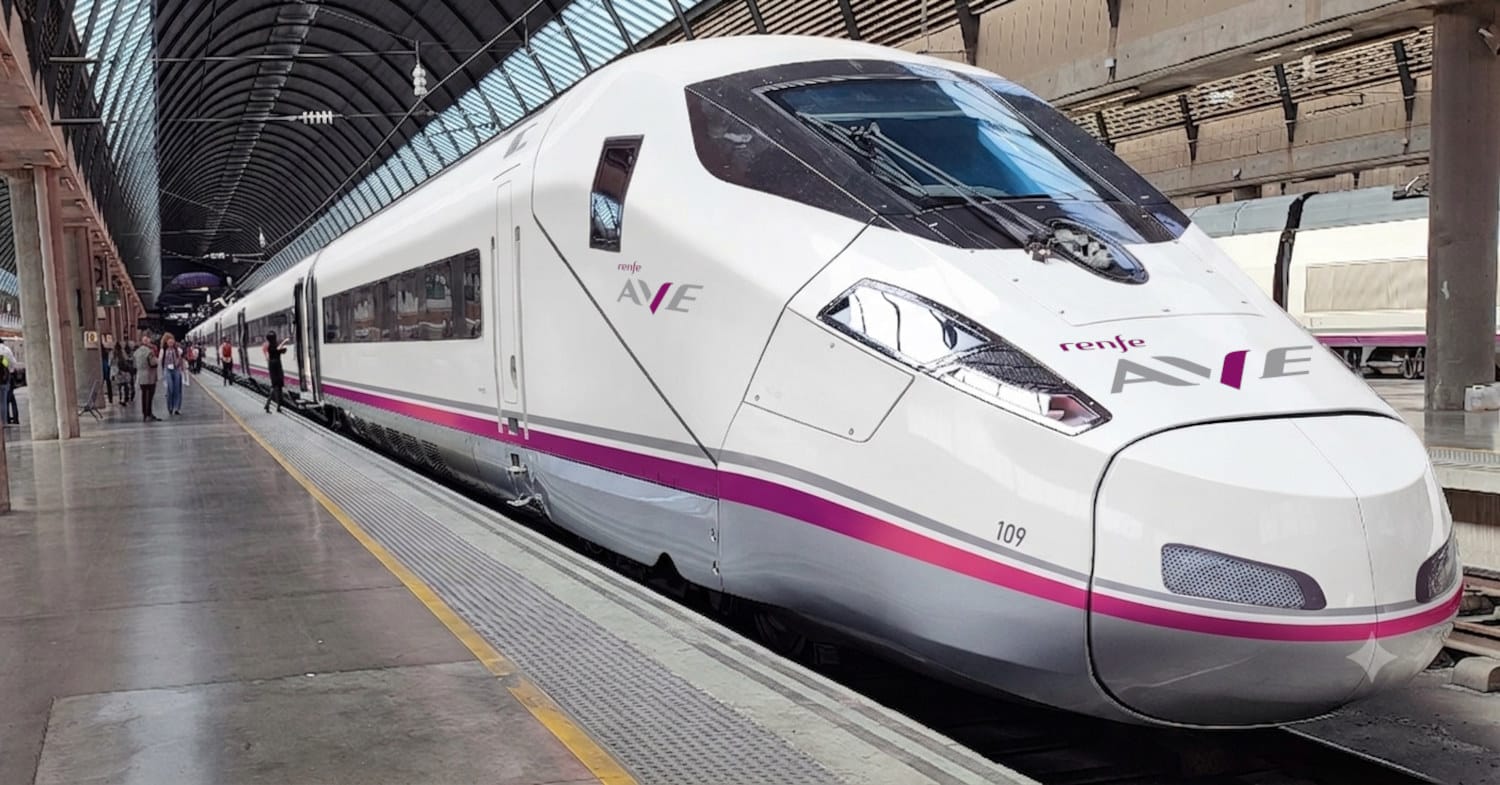
Yesterday, 23 June, marked the deadline for rolling stock manufacturers to submit bids to Renfe for the supply and maintenance of 30 high-speed trainsets, with an option for a further 10 units. The deadline had previously been extended at the request of bidders.
Renfe has not yet disclosed which companies have taken part or which platforms have been proposed. However, there is broad consensus within the sector that Hitachi’s ETR 1000 is the clear frontrunner, with some sources even suggesting the specification may favour it.

Stringent technical requirements
As previously reported, the tender specifications remain strictly confidential, having been distributed directly to manufacturers under non-disclosure agreements. Renfe justifies this approach due to the competitive environment in both Spain and France, where the trains may also operate.
Confirmed requirements include:
- A maximum commercial speed of 350 km/h.
- Delivery of the first units fully authorised within 40 months of contract award, followed by a production rate of one train every six weeks until completion at month 78.
These constraints imply that bidders must offer a platform already in series production and at least partially authorised within the EU, as well as designed for 350 km/h operation.
At present, only three train families meet these criteria: Hitachi’s ETR 1000, Alstom’s Avelia Horizon, and Siemens’ Velaro neo. None is currently authorised above 320 km/h, although all are designed for 350 km/h commercial operation. CAF and Talgo do not currently offer trains designed for such speeds, nor do they have active production lines meeting these requirements.
One technical requirement believed to be under consideration is distributed traction. If confirmed, this would effectively exclude the Avelia Horizon, leaving Alstom with the Avelia Stream platform, which combines Bombardier’s Zefiro and Alstom’s Pendolino technologies.
However, neither platform is currently in active production, potentially complicating compliance with Renfe’s demanding delivery schedule.
Notably, the ETR 1000 is technically designated V300 Zefiro, reflecting its joint development by Bombardier (now part of Alstom) and Ansaldobreda (now part of Hitachi).
Authorisation: the critical bottleneck
The European rail supply industry is currently facing significant delivery delays, partly attributed by manufacturers to increasingly complex certification processes and limited access to test infrastructure.
This makes prior authorisation a decisive factor. Both the ETR 1000 and Avelia Horizon meet this condition, with the former already authorised in Spain, albeit in its first-generation configuration using Bombardier/Alstom technology.
Hitachi is expected to propose the second-generation ETR 1000, featuring in-house systems, improved energy efficiency, and design enhancements such as increased luggage space.
This version is already authorised in Italy and, as an evolution of an existing platform, has undergone a relatively streamlined approval process. Certification in Spain and France is therefore expected to be less complex, with additional approvals underway in countries such as Austria.
Other potential contenders
Siemens is the only manufacturer to have publicly hinted at its bid, potentially offering the Velaro Novo. However, this platform remains at prototype stage, with only a single trailer car under testing. Without series production or prior authorisation, meeting Renfe’s timeline appears unlikely.
A more credible Siemens option would be the Velaro neo, which offers similar characteristics to the ETR 1000 but lacks authorisation in Spain.
Alstom could remain competitive with the Avelia Horizon, provided the distributed traction requirement is not enforced. This platform offers very high passenger capacity without resorting to high-density 3+2 seating or lightweight seats that compromise comfort to meet axle load limits.
Both the Spanish Ministry of Transport and Renfe have also explored potential engagement with China’s CRRC. While the manufacturer has substantial production capacity, full platform authorisation from scratch would be required, making compliance with the delivery schedule challenging.
Renfe will assess the technical proposals over the summer and open the financial bids, weighted at 30%, on 9 September. Contract award is expected before year-end, after which the 40-month delivery timeline will commence, subject to any legal challenges.