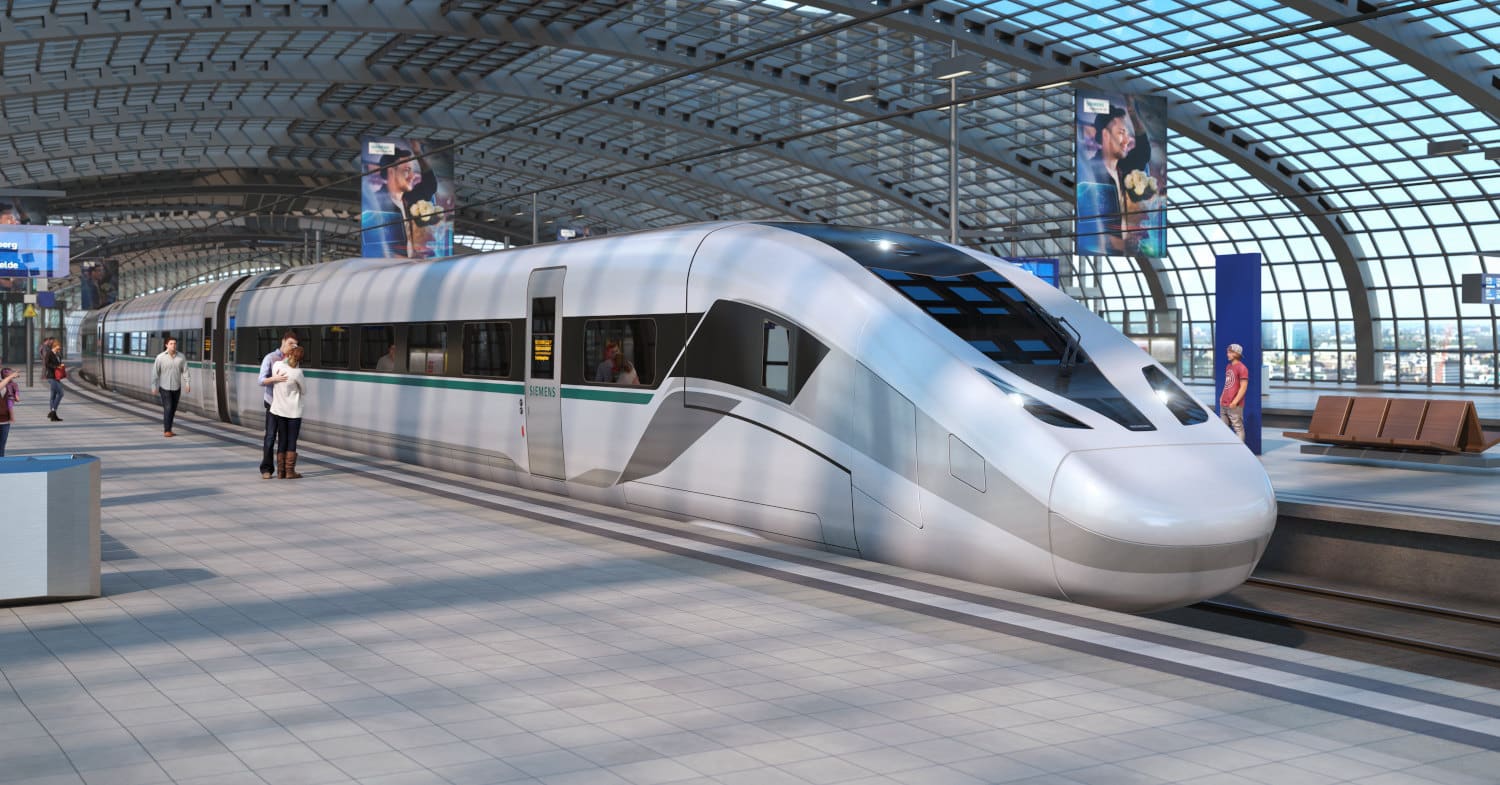
With limited time remaining for rolling stock manufacturers to lodge bids to supply and maintain 30 high‑speed trainsets for Renfe, with an option for 10 more, the operator has extended the deadline to 23 June.
Although widely anticipated, Siemens has now confirmed it is assessing a proposal based on the Velaro Novo rather than the Velaro neo. This follows remarks by Ricardo Ramos, CEO of Siemens Mobility for Spain and Southwest Europe, in an interview with ElEconomista.

Ramos noted that “we are evaluating presenting the Velaro Novo platform, the natural evolution of the Velaro (Renfe Class 103) that has been in service here for two decades”.
As an evolution beyond the Velaro neo (DB Class 408), the Novo delivers markedly improved energy efficiency, consuming around 30% less energy at 300 km/h, equating to annual savings of approximately 1,375 tonnes of CO₂. This is complemented by a 15% reduction in mass through lightweight construction and a 10% increase in passenger capacity.
A key feature is its “empty tube” concept, which removes fixed onboard equipment from the carbodies, enabling a fully modular interior that can be reconfigured in line with operator requirements, even years after entry into service.
For maintenance, the platform incorporates advanced condition‑monitoring sensors, enabling continuous diagnostics and significantly lowering lifecycle costs.
However, the Velaro Novo currently lacks an active production line and has not yet secured homologation in any European country, factors that could challenge Siemens in meeting a delivery schedule targeting entry into service within four years. Notably, Deutsche Bahn opted for the Velaro neo in its most recent procurement, favouring a lower‑risk solution following delivery delays with earlier variants, albeit with some Novo-derived innovations incorporated.
Barring late changes, the principal competitor is expected to be Hitachi’s ETR 1000, which is better aligned with the proposed timeline. Its second generation, addressing first‑series shortcomings and replacing Alstom technology with Hitachi systems, is already in production and undergoing multi-country homologation, facilitating faster deployment for Renfe.
Alstom may also table the Avelia Stream, derived from the AGV and Bombardier Zefiro platforms (the latter underpinning the ETR 1000). However, this train family has yet to be built or certified. Given the apparent requirement for distributed traction, the Avelia Horizon is effectively excluded.