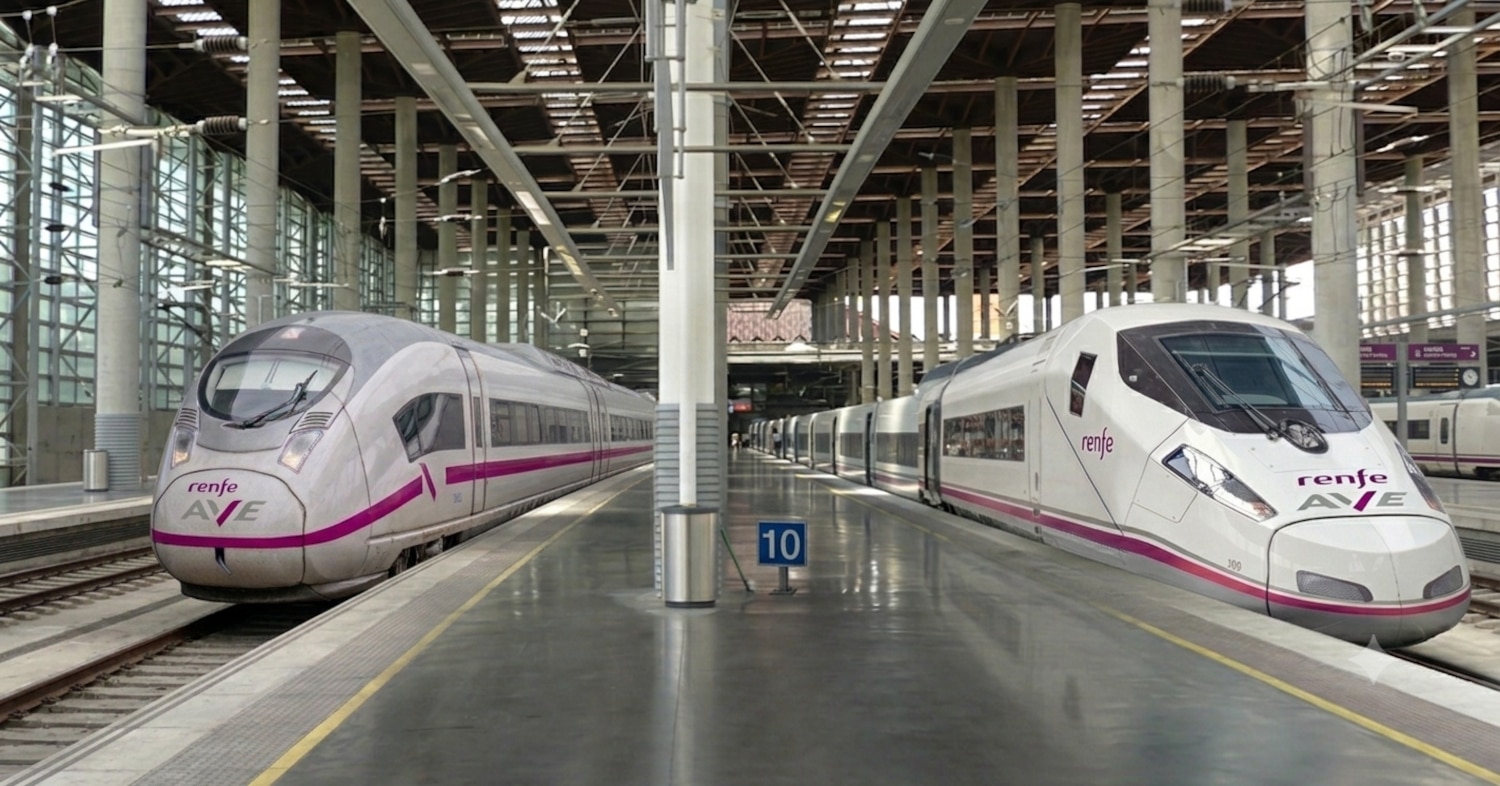
Only two manufacturers will ultimately compete for Renfe’s order for 30 high-speed trainsets, with an option for 10 more. Siemens, Hitachi and Talgo submitted bids, but the Spanish builder did so after the deadline.
Renfe’s procurement for up to 40 high-speed units has therefore narrowed to a head-to-head between Siemens Mobility and Hitachi Rail. The submission deadline closed last Tuesday. According to Víctor de Elena in ElEconomista.es, three bids were lodged, including Talgo’s; however, it was immediately disqualified for late delivery and was not evaluated. Alstom ultimately chose not to participate.

The tender covers an initial order of 30 trainsets valued at €1.362bn, with an option for 10 additional units bringing the total to €1.777bn. The schedule is particularly demanding, as Renfe requires the first units to be delivered already homologated within a maximum of 40 months.
Hitachi ETR 1000
Hitachi’s ETR 1000 is widely seen as the frontrunner. The platform is already operated by Trenitalia and Iryo in Italy, France and Spain under the Frecciarossa 1000 brand. It is unclear whether Hitachi has offered the first-generation variant, akin to Iryo’s Class 109, or the second-generation version now in service in Italy. The latter replaces technology not transferred by Alstom with in-house systems and incorporates improvements in energy efficiency and passenger comfort.
Velaro by Siemens Mobility
Siemens has publicly considered offering the Velaro Novo, designed for commercial speeds of up to 360 km/h. However, this remains a largely developmental platform: only a single trailer car has been built for certification and testing, during which it reached 405 km/h, enabling a potential service speed of 350 km/h.
At present, the Velaro Novo has no firm orders in Europe, lacks an active production line and does not yet have a complete trainset available for full homologation. To meet the tight delivery window, the more viable option would be the Velaro MS (ICE 3neo or Class 408), an evolution of the Velaro D incorporating elements from the Novo and already in service in Germany, Belgium and the Netherlands. A hybrid specification combining the Velaro MS with further Novo innovations also remains a possibility.
A track capable of speeds of 385 km/h is required
A further constraint is the need to undertake dynamic testing at 385 km/h, required to certify operation at 350 km/h. This speed has previously been exceeded during trials of the Class 103, the only European train authorised for 350 km/h operation. On 16–17 July 2006, unit 103-002 set Spain’s rail speed record at 403.7 km/h on the Madrid–Barcelona high-speed line.
However, current infrastructure condition makes achieving the required test speed unlikely, although comprehensive renewal works are due to begin precisely on that section.