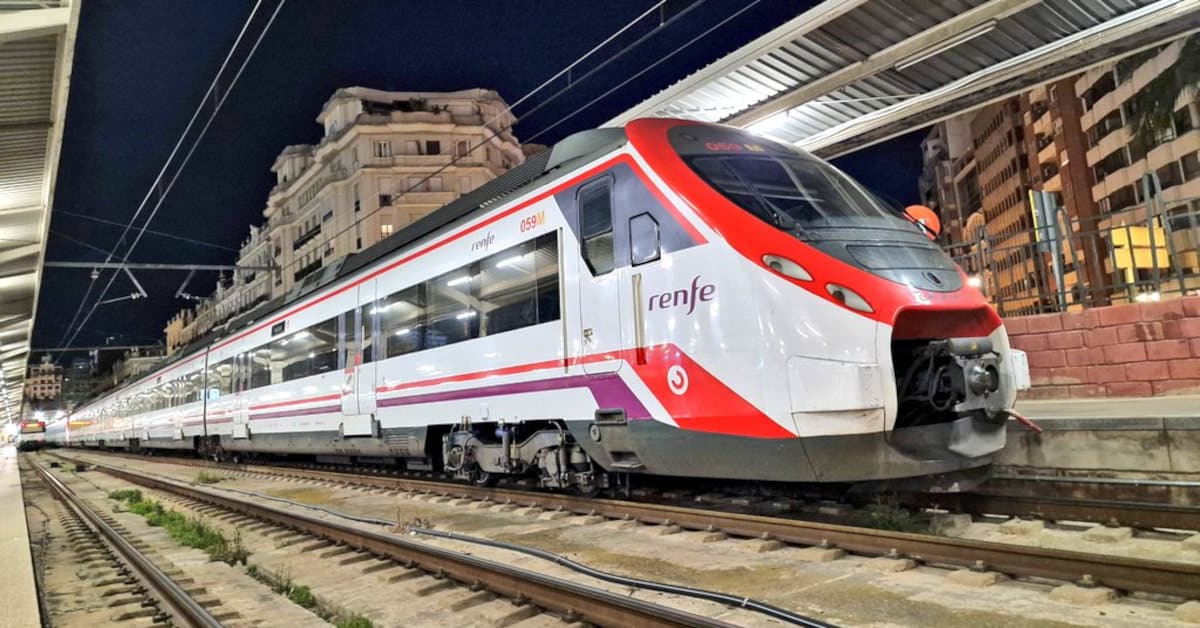
The transfer of 41 Class 465 EMUs from Cercanías Madrid to Cercanías Valencia has sparked intense debate, driven by the age of the rolling stock.
While some political parties are calling for new trains and social media repeats that trains built in Valencia should stay in Valencia – or that Valencia is receiving Madrid’s cast-offs – the units now being assigned to its commuter network are up to 23 years old.

In response to the controversy, Renfe has issued an explanation on the replacement of the Class 447 and 464 fleets by Class 465 units. The operator maintains that the change aims to increase capacity by more than 30% in the face of rising demand.
Each unit’s capacity rises from 549 to 748 places, with seated seats increasing from 219/233 to 277. Twenty-two units will arrive in 2026 and 19 in 2027, reducing the average age of the Valencian fleet from 27.8 to 17.2 years. The network will move from 75 m trains (three-car 447s) and 80 m trains (four-car Civia 464s) to 100 m trains. However, they will operate in single formation only; double-heading will not be possible on lines C-1 and C-2 due to platform length constraints.
Refurbished trains
Before the transfer, Renfe says it will invest more than €7 million in inspections, interior and exterior refurbishment, and updates to passenger information systems. On top of this comes accumulated heavy maintenance (R1, R2 and IM4 interventions), equivalent to around €80.69 million.
With an estimated service life of 40 years, these trains – until now the most modern in Cercanías – still have plenty of life left and are more reliable: 487,934 km between incidents versus 211,292 km for the replaced series.
The capacity boost will be accompanied by additional frequencies in September: 10 extra services on C-1 (Valencia–Gandía) and seven on C-6 (Valencia–Castelló), reaching 79 daily services on both and improving connections with the UPV campus in Gandía.
Renfe argues that the withdrawal from Madrid is not due to age but to infrastructure saturation (the Recoletos and Sol tunnels), which prevents frequency increases. For this reason, the 465s and older stock (Classes 446 and 450) are being replaced in Madrid by high-capacity trains.
Madrid records more than 200 million journeys a year, about ten times as many as Valencia. Some Class 447 units are being transferred to the Basque Country to improve accessibility, while Madrid’s oldest trains are set for withdrawal as they approach 40 years of service.
Train swaps are routine
Although Renfe does not include this in its explanation, Trenvista adds that rolling stock exchanges are common on compatible rail networks.
Notably, Class 465 EMUs from Cercanías Madrid have already operated in Valencia during the Fallas festival.
For operational reasons, some trains change their base of operation several times during their service life. Some of the 447s that have been working in Valencia and are now moving to Bilbao previously served in San Sebastián and Madrid. Although they are over 30 years old, in Bilbao they will bring two features the network lacks: accessibility and a maximum speed of 120 km/h, compared with 100 km/h for the Class 446.
When Madrid transferred its entire Class 447 fleet to other networks after refurbishment for accessibility, it received older, non-accessible Class 446 trains in return.