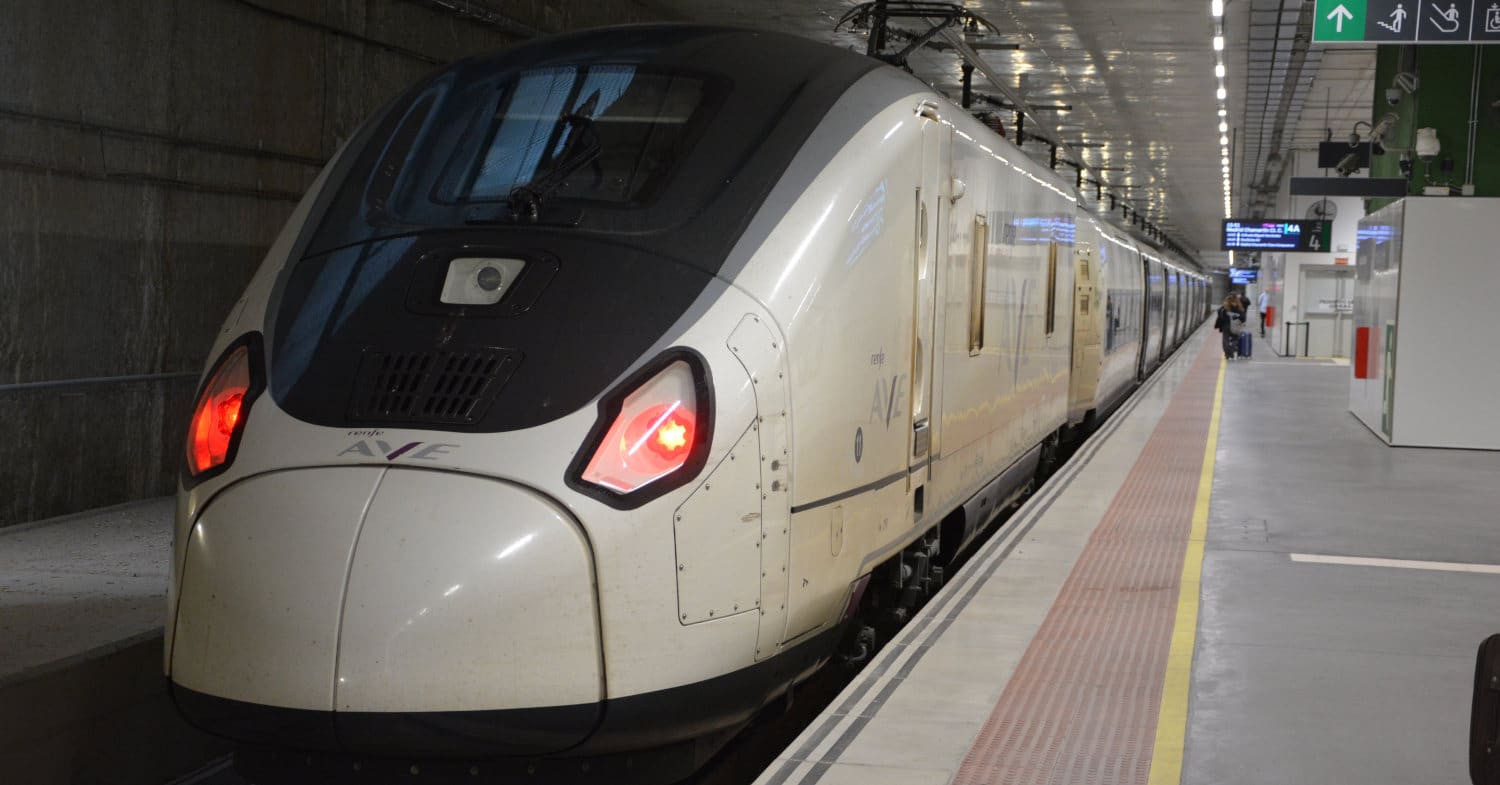
Renfe and Talgo have definitively resolved the situation of the Series 106 trains, based on the Talgo Avril platform, with an agreement that revises the original concept. The state operator will convert the 15 trainsets initially designed for fixed gauge into variable-gauge units, so the entire fleet shares the same gauge‑changing running gear, which has not exhibited the cracking issues seen on fixed‑gauge trains.
This entails an investment of €132 million.
A strategic shift that will enhance Renfe’s competitiveness
With this change, all Avril trainsets will be able to operate seamlessly on both standard-gauge and Iberian-gauge routes at up to 300 km/h; subject to certification, the limit could rise to 330 km/h. This supports capacity on corridors being upgraded towards 350 km/h, where Avril and Series 107 units can replace Series 120, 130 and 730 trains, whose 250 km/h ceiling constrains other traffic.
In addition, having 15 variable‑gauge high‑speed trainsets capable of 300 km/h strengthens Renfe’s position ahead of the second phase of market liberalisation, as many routes combine both gauges. In total, the operator will have 43 very high‑speed trains able to run on both networks.
Although the change would not preclude operation in France, it clearly signals that Renfe does not intend to deploy the Series 106 there. Their replacement will most likely be the trains tendered this spring.
Converting the 15 fixed‑gauge Series 106 units to variable gauge will standardise the fleet, leaving 20 variable‑gauge sets for AVE services and 10 high‑density units (3+2 seating only, no café) for Avlo.
Renfe had planned to replace Confort‑class seating, although this has not yet materialised and the contract with Talgo does not appear to include this upgrade.
Offsetting the €116 million penalty?
Financially, some observers suggest the deal effectively cancels the €116 million penalty imposed by Renfe on Talgo for delayed delivery of the Series 106. It is €16 million less than the cost of the conversion, although this depends on the final cost of replacing bogies and running gear.
The conversion programme will run for just over three years. Talgo will carry out the full modification, with first deliveries expected from month 15, enabling phased entry into commercial service.
The manufacturer will also assume long‑term commitments regarding the performance of the variable‑gauge bogies, including potential interventions on frames if required. These guarantees align with future developments such as the Series 107, which uses the same bogies and running gear.