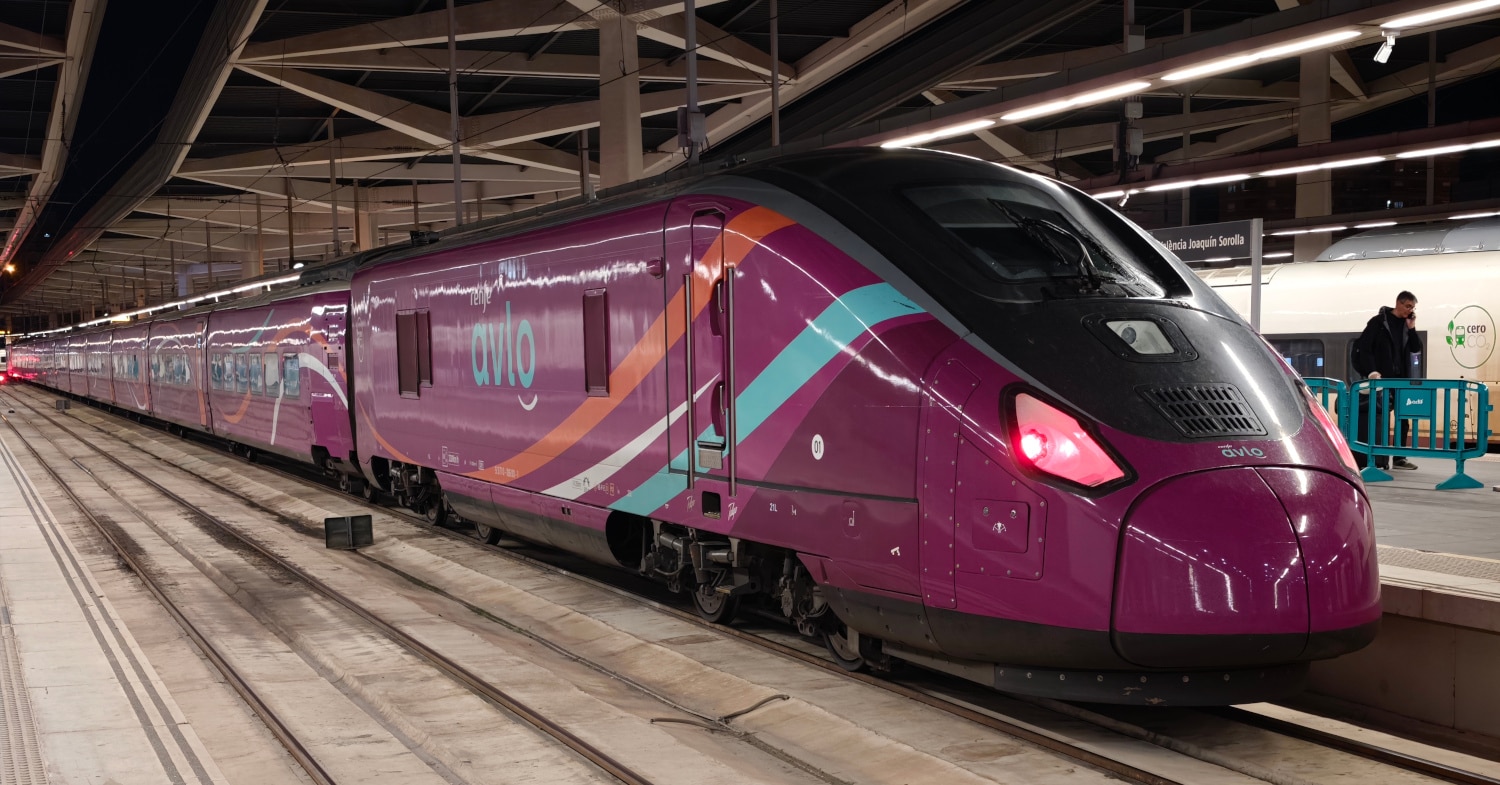
The problems with Renfe’s Series 106 – the Avril trains built by Talgo – continue to mount. The operator has taken another two trains out of circulation after fresh bogie cracks were detected during the last week of August. These are two fixed-gauge units assigned to the Madrid–Levante corridor.
The findings emerged under an enhanced inspection programme that Renfe has maintained on this fleet since July 2025, when the first cracks appeared in the bogie frames of five fixed-gauge units operating Avlo services between Madrid and Barcelona. At the time, the manufacturer pointed to poor track condition as the trigger for the issue.

Renfe has stressed that it will keep out of service any set where there is doubt over the condition of these components, authorising return to traffic only after passing the established technical checks. According to the operator, its monitoring techniques allow early-stage indications to be identified and preventive measures adopted before they can affect in-service behaviour.
Infrastructure ruled out as primary cause on Madrid–Barcelona corridor
Since cracks were first found on some of the five fixed-gauge Series 106 trains covering Avlo Madrid–Barcelona, the fleet has not run over the Madrid–Calatayud section – the most affected stretch. A Tarvia report had flagged infrastructure condition as the origin of the cracks, given that this was where the highest vibrations were recorded.
However, Adif maintained that the line met the conditions for 300 km/h operation, and the two trains withdrawn at the end of August have not run on this corridor. This allows the infrastructure condition on that route to be discounted as the main cause of the damage, pointing instead to a manufacturing defect – at least for now – which does not affect the variable-gauge bogies.
Renfe has asked the manufacturer to deepen its root-cause analysis, determine the full scope of the problem and adopt the technical measures needed to guarantee bogie reliability on units currently in service.
Talgo continues to investigate the origin of the defects, having carried out additional test campaigns using strain-gauge measurements on various high-speed lines, with initially positive results, and with bench tests still pending to complete validation. Even so, the fixed-gauge variant is close to disappearing.
Entire Series 106 to be converted to gauge-change wheelsets
The withdrawal of these two trains comes two months after Renfe and Talgo agreed to convert all 15 fixed-gauge Avril trains into variable-gauge sets. The €132 million operation aims to homogenise the fleet technically, with the objective of enabling services into Portugal. In addition, maintenance costs have been agreed to rise despite the simplification of the fleet.
The conversion will be executed over 37 months, with the first modified units expected to be ready from month 15. The 30-train fleet will then be split into 20 sets with AVE-style interiors (two classes and a buffet car) and 10 for Avlo services (single class, no buffet).
Talgo must guarantee correct operation of the new bogies over the planned service life, carrying out at its own expense any improvements that may prove necessary in the frames. These guarantees also extend to Series S107 trains, which use the same bogies.
The shift to gauge-change wheelsets will give the S106 fleet greater versatility, allowing operation on both international-gauge and Iberian-gauge lines, including the two 1,668 mm high-speed routes. This flexibility is key to reinforcing services on corridors such as Galicia, Asturias, Cantabria, Huelva and Cádiz, which are affected by the so-called second phase of rail liberalisation.
Enhanced monitoring with safety as priority
Renfe has reiterated that it will maintain enhanced surveillance across the entire Series 106, regardless of the lines over which they have run, and will continue to withdraw preventively any stock where inspections reveal indications requiring further analysis. The operator considers it essential that driving and maintenance staff have all necessary guarantees to carry out their work.
The control and monitoring plan, drawn up in consensus with the Spanish Railway Safety Agency, is proving effective in detecting bogie issues before in-service incidents occur and enabling the necessary measures to be taken.