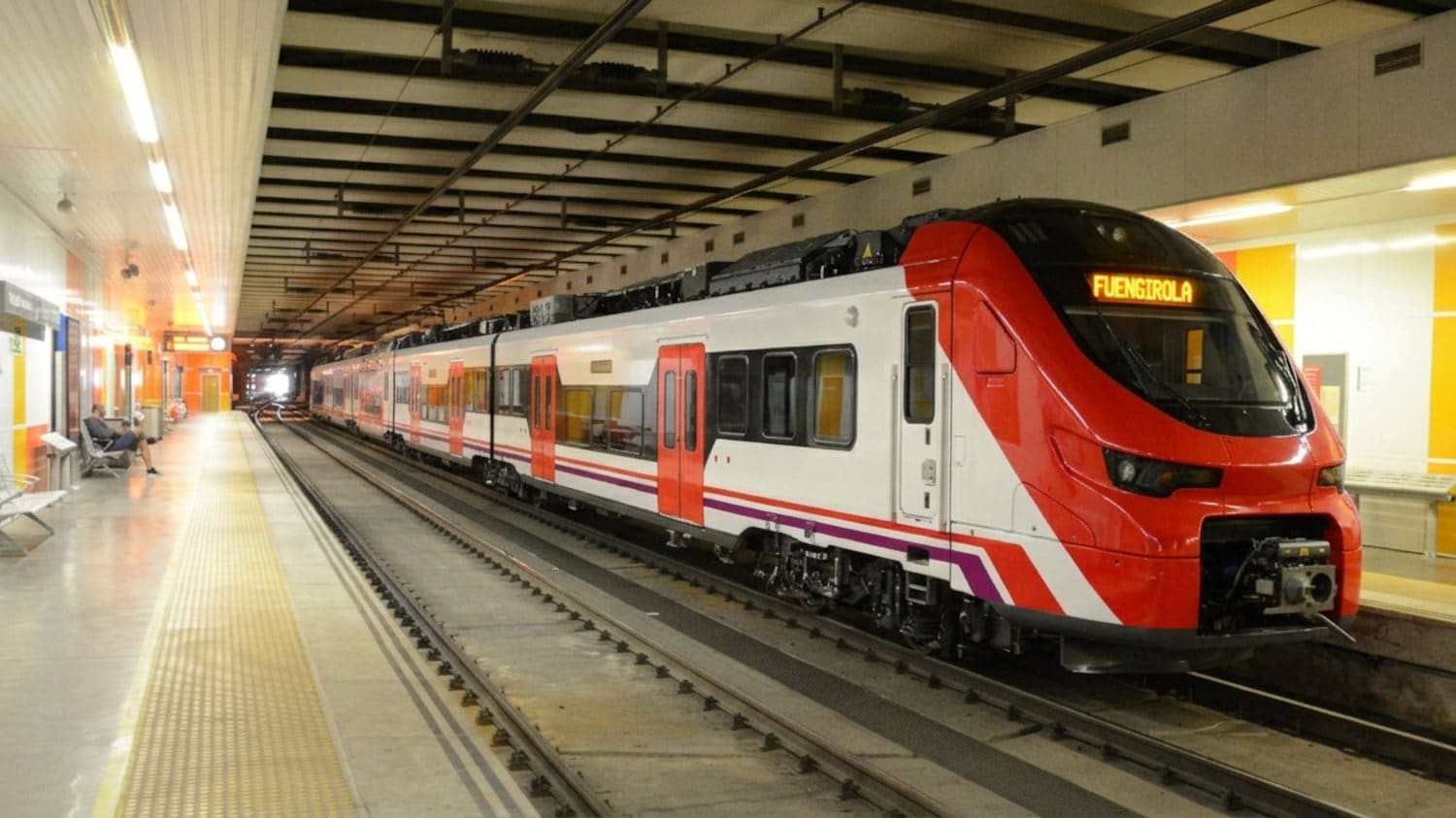
The Málaga commuter network will see a major operational boost from 2028. Renfe has announced it will assign seven new 452-series trains to strengthen the C-1 line, which links Málaga with Fuengirola.
A technical solution to infrastructure limits
The decision to opt for higher-capacity trains responds to two technical constraints on the line. At 32 km long, the C-1 combines double-track sections—Málaga María Zambrano–Aeropuerto, Campamento–Los Álamos–La Colina, El Pinillo–Benalmádena and Torremuelle–Carvajal—with single-track stretches that make up nearly half the route. This fragmented configuration prevents headways from being reduced below 15 minutes with the required regularity and reliability, even if more trains were added. In addition, platform lengths preclude the operation of double formations.

Currently, the C-1 runs at 20-minute intervals and is already at maximum operational capacity. In 2025, the Málaga commuter network recorded 15,542,731 passengers, heavily concentrated on this line, which at peak times reaches 150% occupancy of seated places.
High-capacity Alstom trains
The 452-series units are being built by Alstom in Barcelona. Each comprises six cars (two double-deck) and is 100 metres long. They offer 245 seats and a maximum capacity of up to 900 passengers. This will be the first time a train with double-deck cars operates regularly outside Madrid and Barcelona, which have had 450-series trains since the 1990s. This addition is part of a fleet reorganisation plan that also includes replacing Valencia’s 447 and 464 units with 465s from Madrid.
New maintenance depot and complementary investment
Alongside the arrival of the new trains, Renfe plans to build a dedicated maintenance depot for Málaga commuters, with a €40 million investment and works due to start in 2027. This facility will ensure the units have the technical resources needed for inspections and maintenance. The new trains incorporate predictive maintenance systems: using sensors and dedicated software, the train will flag components likely to fail before breakdowns occur, reducing both cost and downtime.
The current Málaga fleet consists of eight Civia 464 trains, with an average age of 18.9 years—one of the youngest in Spain relative to their 40-year design life. Since entering service, these units have undergone on average two R and R2 overhauls and three IM4 interventions, representing a total investment of €13.13 million.
Station accessibility upgrades and platform extensions
Renfe also has works planned to improve accessibility at El Pinillo, Los Álamos and La Colina stations, with a total investment of €6.81 million. The works include comprehensive upgrades to access routes, platforms, surfacing, platform edges, levels, canopies, lifts, lighting, fencing, fittings and subways. At El Pinillo, the project includes extending one platform to 100 metres to match the length of the new trains, replacing lifts with new panoramic units, and fully refurbishing the subway; similar interventions are planned at Los Álamos and La Colina.