Passenger trains between Spain and Portugal could be on the verge of long-awaited news. According to unofficial sources close to the process, Renfe and CP are working on restoring the Madrid–Lisbon connection — albeit as a daytime service.
Daytime Lisbon–Madrid via Extremadura
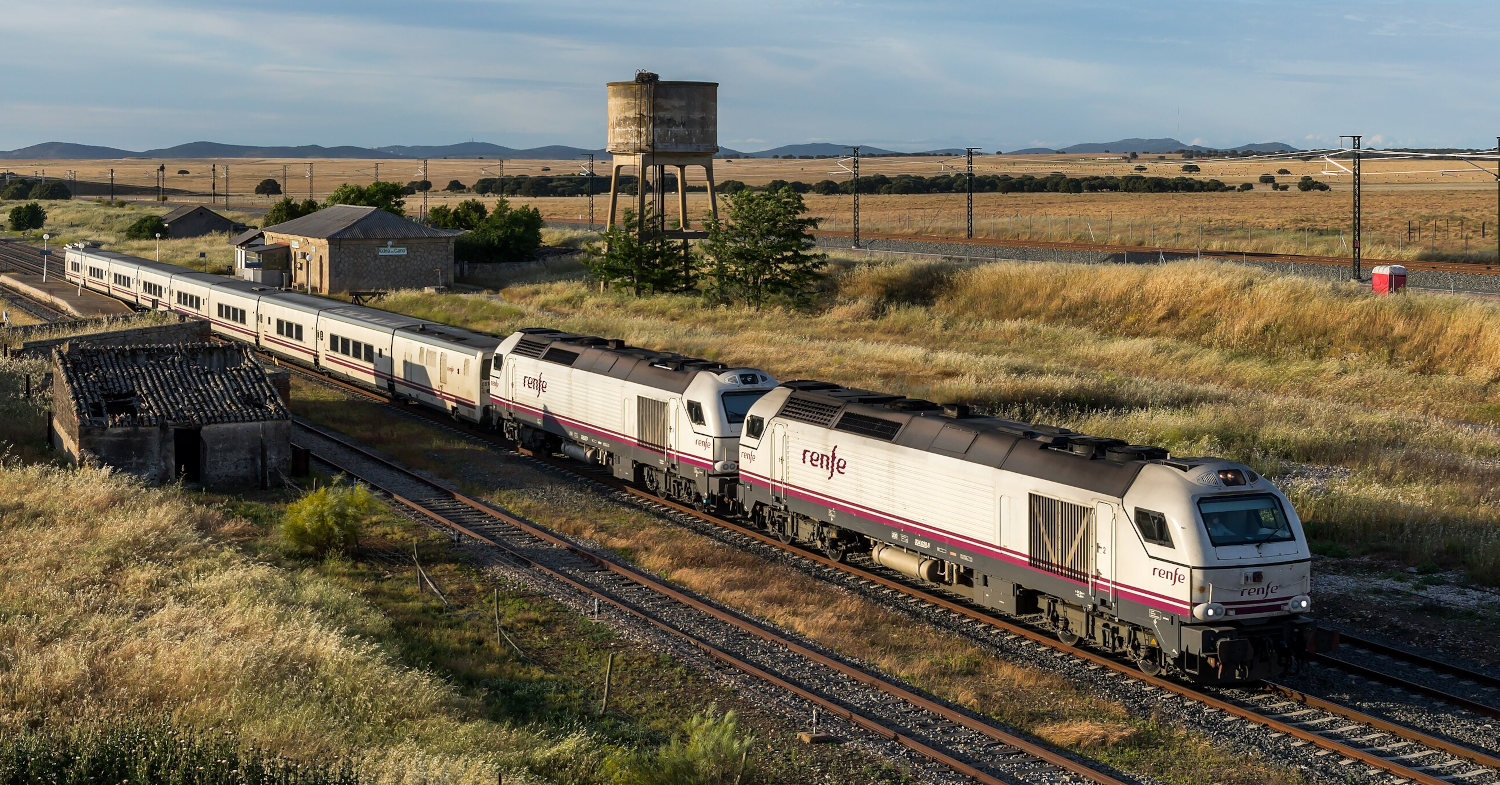
The service would be an Intercity routed via Badajoz, hauled from Madrid by a Class 334 locomotive, and between the Extremaduran city and the Portuguese capital by a Class 5600 using the new Évora–Elvas line, already in testing at 200 km/h. This would mark the return of the Class 334s to high-speed operation, following their replacement by Class 730 units on the Ourense–Santiago high-speed line.

This service would be separate from Renfe’s plans to operate in Portugal with series 106 and 107 trains, announced by Óscar Puente last week.
If confirmed, this would reopen a route closed in March 2020. Until the Covid-19 pandemic, the nightly Trenhotel Lusitania ran daily. Although its historic routing was via Cáceres and Valencia de Alcántara, the closure of the Portuguese section meant that from 2012 it ran via Salamanca, operating coupled to the Sudexpresso between Medina del Campo and Lisbon.
Salamanca has already picked up on this new service. In a column by Carlos Rincón in La Tribuna de Salamanca, the author cites the Extremadura routing as “another blow” to the province.
Renfe does not want night trains due to high operating costs
Although the pandemic-era service cuts were the excuse for suspending the Trenhotel services, in May 2020 Renfe stated it had no plans to resume them. Despite strong demand, both the Lusitania and the Sudexpresso were heavily loss-making due to high operating costs.
As open-access services, Renfe could sustain them with profits from more profitable trains such as the Madrid-Barcelona AVE. That scenario changed with liberalisation.
Since then, both Renfe and the Spanish Government have refused to restore it or designate it as a public service obligation (PSO) to receive subsidies, despite Portugal’s willingness. The operator has also cited a lack of rolling stock, even though the Lusitania and Sudexpresso coaches are unused and vandalised but recoverable.
With the withdrawal of the Madrid–Almería and Barcelona–Valencia Intercity services in September, Renfe was left with only one locomotive-hauled train, the Valencia–Cartagena. However, this new service would extend the working life of the Talgo VI coaches and the Class 334s.
As soon as the creation of this new service is confirmed, we will report it on Trenvista.