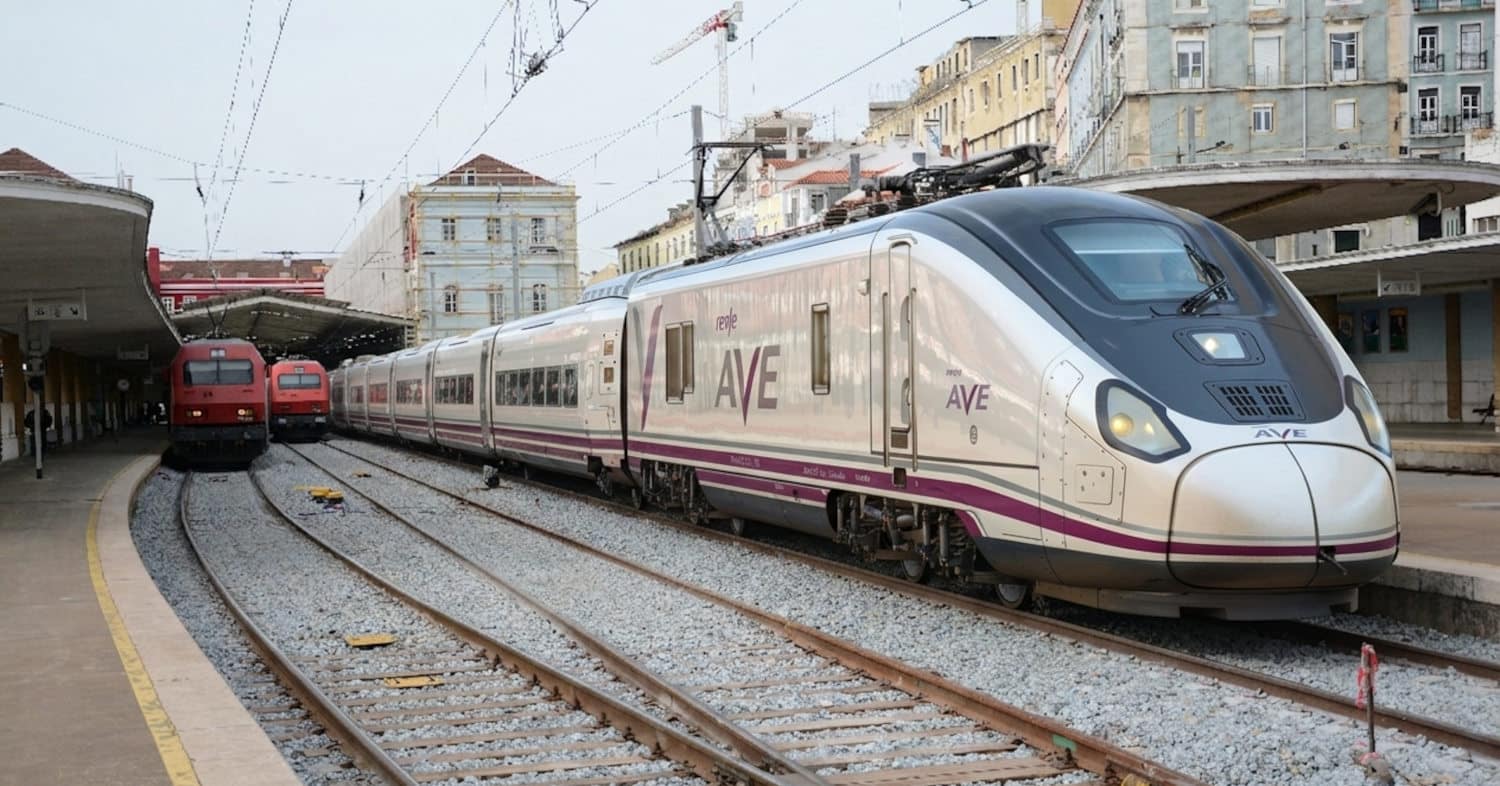
After encountering homologation obstacles with the 106 series (Talgo’s Avril) for operations into France and Paris, Spain’s Minister of Transport and Sustainable Mobility, Óscar Puente, has signalled a shift in Renfe’s international expansion strategy: Portugal is now the priority market.
Puente stated that efforts will focus on homologating both the 106 and 107 series for use on the Portuguese network. Apart from the Vouga line, Portugal’s mainline network uses Iberian gauge throughout, with 25 kV 50 Hz AC electrification (the Cascais line is currently being converted), meaning both Renfe series are technically compatible with the infrastructure. All three cross-border lines are either already electrified or undergoing electrification works.

Compatibility with Portuguese signalling is being addressed via an STM (Specific Transmission Module) developed by Critical Software, enabling the trains’ ETCS equipment to interface with the ATP Convel system used in Portugal. Puente considers entry into Portugal more straightforward than into France and hopes Renfe can capitalise on the momentum of high-speed rail development.
The announcement effectively marks Talgo’s return to the Portuguese market following the withdrawal of Trenhotel night services and the Spanish government’s previous reluctance to reinstate them, despite the absence of direct rail services between Madrid and Lisbon. Talgo is one of two contenders to supply the 12 high-speed trainsets that CP plans to purchase, although several industry experts regard Alstom as the clear favourite.