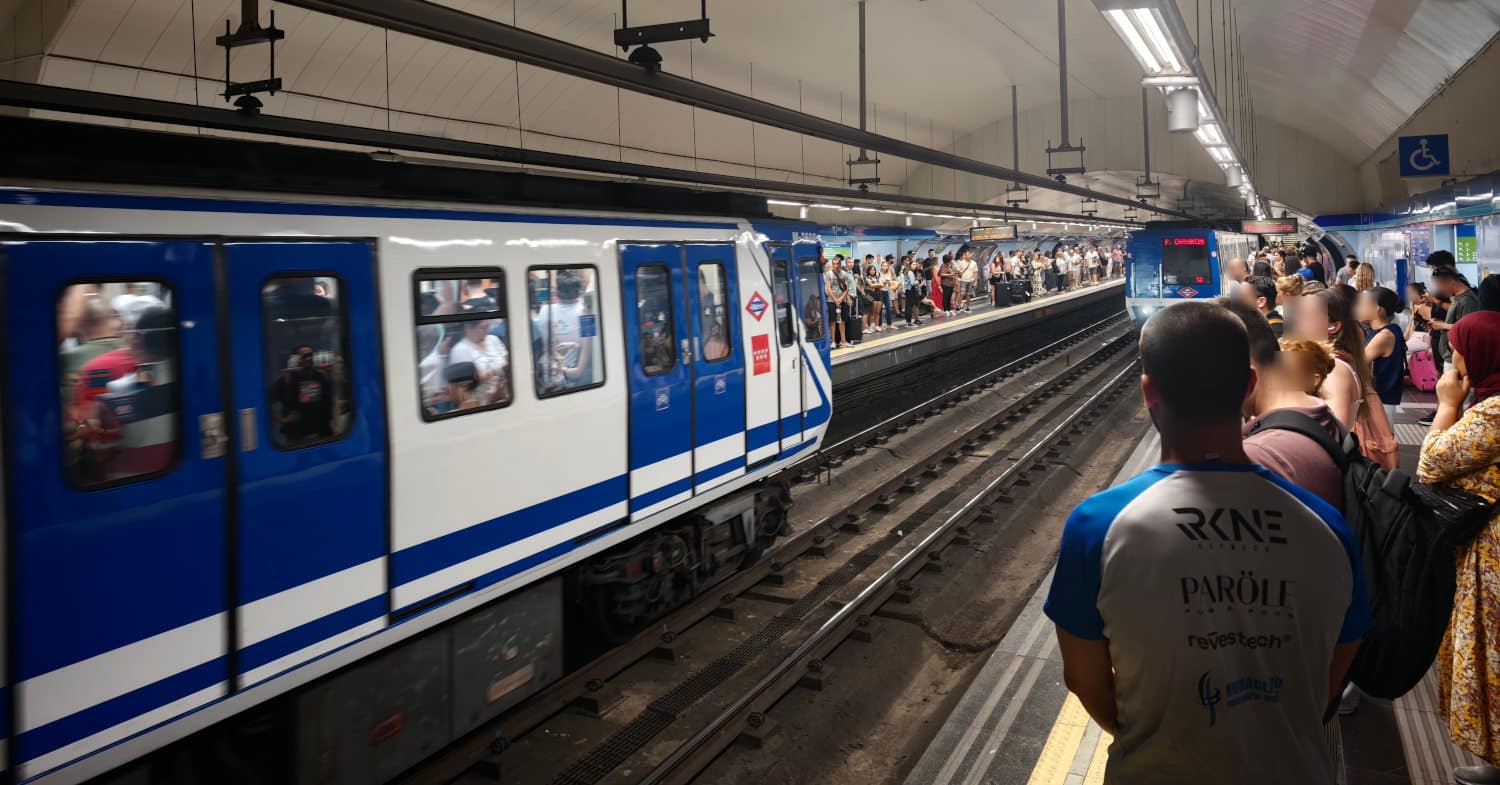
Summer 2026 arrived early, with a heatwave breaking temperature records in June. This heat has only just begun, and over recent weeks the majority of complaints directed at Madrid Metro on social media point in the same direction: the air-conditioning isn’t working.
The problem affects several lines, but hits hardest on Line 1, one of the busiest, as it crosses the entire centre of Madrid and links it to high-demand hubs such as Atocha and Chamartín stations.

This compounds something users of this and other lines have already grown used to: waiting times that keep stretching out, with neither the operator nor the Consorcio Regional de Transportes (the regional transport authority that sets the service levels Metro must provide) offering any explanation. On X, a “Line 1 sufferers” account has even sprung up, attempting to compile all the complaints.
Trains packed to capacity
This is translating into carriages crammed with passengers who, besides the discomfort of overcrowding, are travelling in cars with no air-conditioning. It’s not that the rolling stock lacks the equipment — every train on the network is fitted with climate control — but on some units it simply isn’t working.
On X, Metro’s public customer-service channel, the same complaints have been repeating for weeks: “Stifling heat on Line 1.” Metro asks for the carriage number and, once given, replies “we’re passing this on.”


on reaching the terminus and replaced by another unit. In practice, however, the norm is for that train to remain in service for hours, or even days.
Sometimes the air-conditioning simply doesn’t work, and ventilation depends, at best, on a member of staff deciding to open the few operable windows each carriage has. On other occasions, the climate-control system does work — but in heating mode, in the middle of summer.
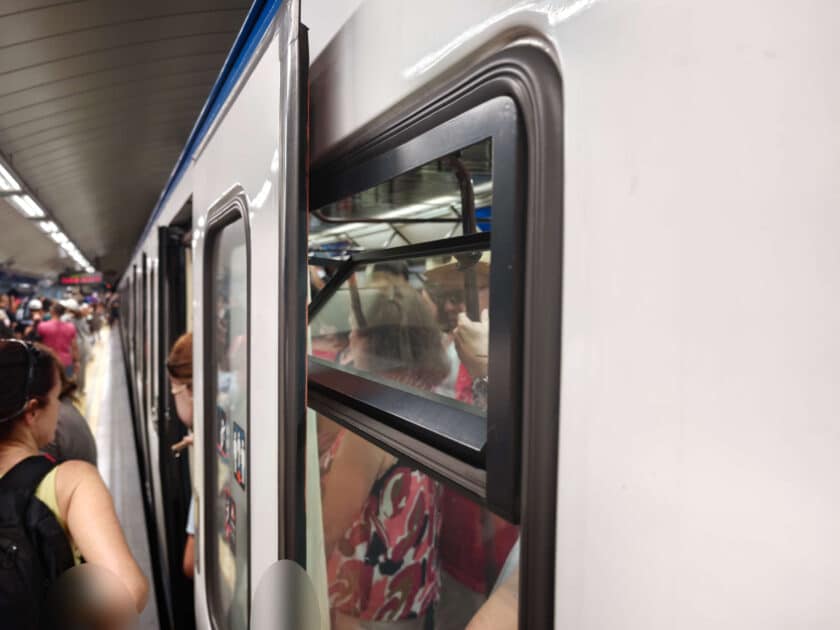
Far from being an isolated incident, this has become a daily occurrence. The same reports crop up every day, and Metro appears to leave them “seen,” with a “we’re passing this on” that some passengers now treat as something of a running joke.
Response from Metro de Madrid
Metro de Madrid’s response
Asked what social-media staff mean by “passing on” this information, Metro told us it goes to the Control Centre (Puesto de Mando). On why the Control Centre doesn’t withdraw the affected trains, this outlet has received no response.
The only thing they say about the air-conditioning issue is as follows:
We are aware of the inconvenience caused by high temperatures. We are therefore working on several fronts to improve passengers’ comfort:
- All trains are air-conditioned.
- Inspections of air-conditioning systems are stepped up during the summer months.
- When a train is detected to have a fault with its air-conditioning system, it is taken out of service as soon as possible.
- In summer, the automatic door opening function is deactivated on most rolling stock (on all vehicles where this is technically possible) upon arrival at the station, in order to maintain the interior temperature.
- Platform cooling systems have been installed at 20 stations on Lines 1 and 5 (for the third year running). Metro continues to step up its investment in climate control.
- An investment of 3.5 million euros has recently been approved to upgrade and optimise the air-conditioning systems on 93 trains on lines 1 and 5.
Anyone following Metro on X will likely recognise this wording — it’s what’s being repeated to passengers who raise the issue.

Many users question part of this message, since trains are not actually being withdrawn. This may stem from operational constraints, though Metro provides no further detail. A good number of passengers also point out that air-conditioning problems on the Series 2000 units have recurred for several summers running. Moreover, that €3.5 million investment arrives just as some of these units are due to be phased out ahead of summer 2027, once replaced by new CAF-built trains.
Inadequate service levels
Although waiting 5 minutes or more for a train is commonplace, Metro maintains that average waiting time stands at 3 minutes, and that Line 1 service has been boosted by 10% this summer compared with last year.
The reality is that it’s increasingly difficult to travel on anything but overcrowded trains along the central section of a line equipped with CBTC signalling and a rolling-stock fleet (almost the entire Series 2000-A) sufficient to run trains every 2 minutes with total fluidity.
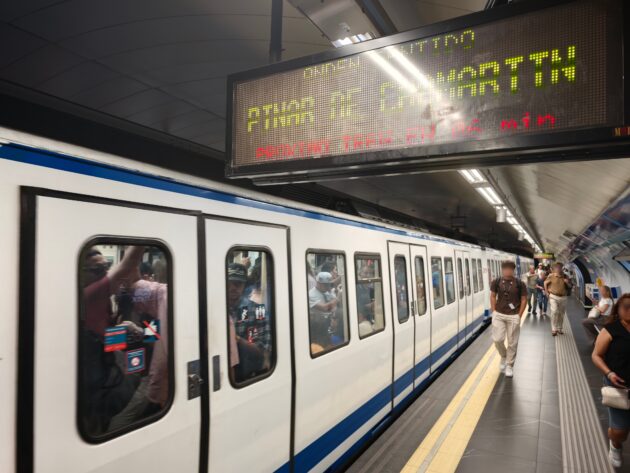
This overcrowding, combined with the air-conditioning failures, can lead to fainting and other health incidents among passengers — entirely avoidable problems that no one travelling on public transport should have to endure, and which tarnish the image of both this mode of transport and an operator that knows it can do better. What’s more, a passenger requiring medical attention can disrupt service and worsen the underlying problem.
Metro needs to strengthen service levels to prevent overcrowding and ensure sufficient reserve trains are available to replace units with climate-control faults. Greater transparency — and a degree of self-criticism — is also overdue.
The Series 2000-A units have two years of service life remaining. During that time, they need to be kept in proper working order to deliver a decent service.