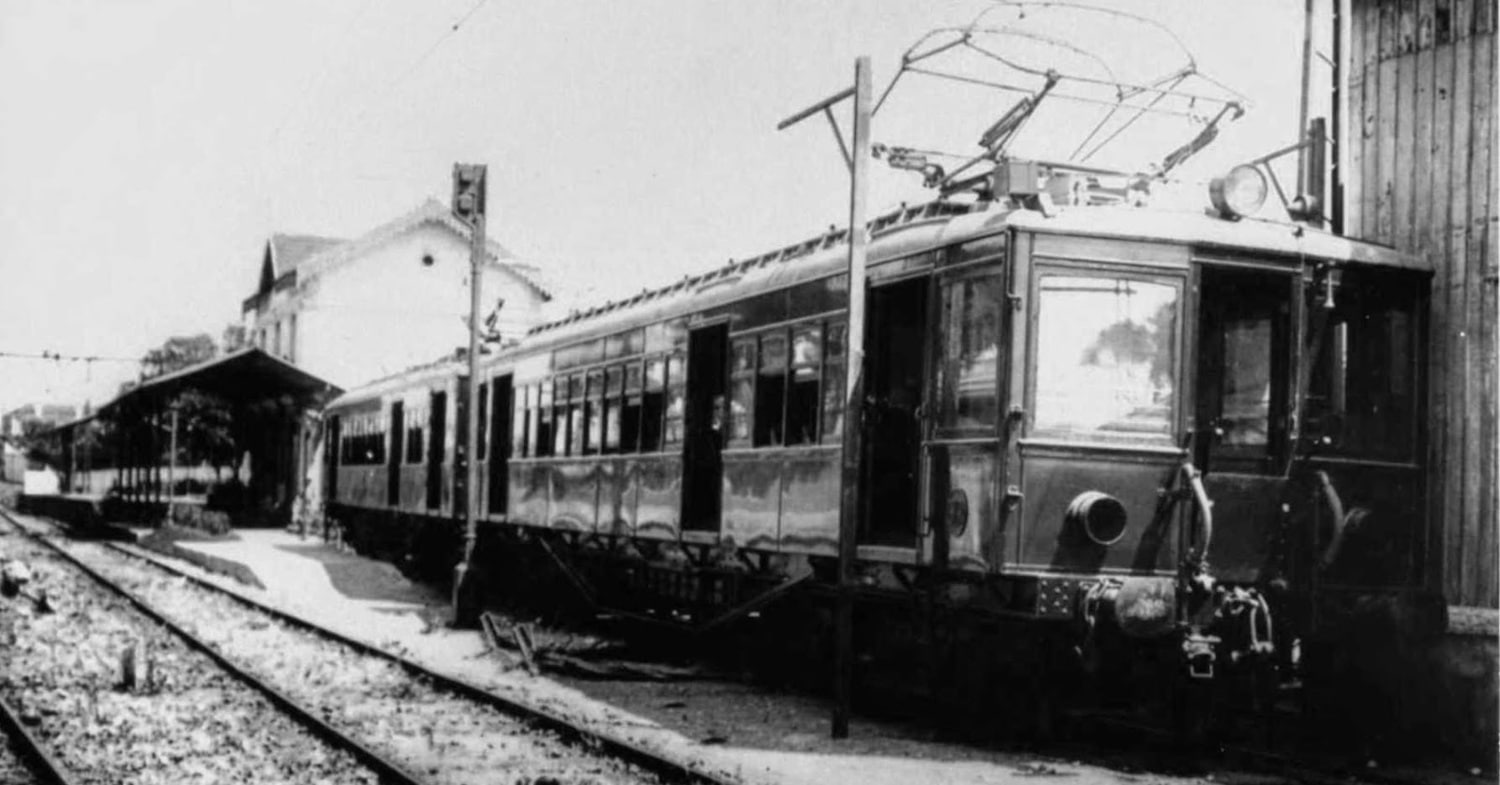
Rail electrification has transformed the way people travel in Portugal. It has made it possible to speed up services, increase the frequency of trains and reduce dependence on coal and imported fuels. Today marks 100 years since the inauguration of the first electrification scheme — a process that did not begin on the Northern Line, but on the Lisbon coast, where trams forced the Cascais railway to reinvent itself.
An adventure that began on the trams
As with any good adventure, there is always a compelling reason. In this case, it was competition from the trams, which, from the end of August 1901, began running between Cais do Sodré and Algés, on a route running almost parallel to the Cascais Line.

The trams offered a better service than the steam trains of the Royal Portuguese Railway Company. Along the first 7 km of the railway line there were eight intermediate stops, whilst Carris offered a more frequent service, with departures every ten minutes. Little by little, the trams began to win over passengers.
Faced with a decline in passenger numbers and a fall in revenue, the Royal Company was forced to seek an alternative. Electrifying the line seemed the logical solution, but at the start of the 20th century, railway electrification was still an extraordinarily costly investment. The immediate solution involved reaching a fare agreement with Carris.
The Estoril project
In 1913, one of the directors of what was then the CP (Companhia dos Caminhos de Ferro Portugueses), Fausto de Figueiredo, proposed setting up a company to promote the development of tourism in the Estoril region. The project included the operation and full electrification of the Cascais Line.
The following year, the necessary legislation to regulate the operation was passed. The Portuguese Railway Company (CP) was authorised to launch a tender for a sub-concession of the line, subject to one key condition: the route had to be electrified.
The winner was Sociedade Estoril, linked to Fausto de Figueiredo. The concession was to last for 50 years, starting from the commencement of electricity generation.
The first electrification
During the first half of the 1920s, work began on installing the catenary, the traction substations and the equipment required for the new system. AEG supplied some of the electrical equipment and two railcars, whilst seven railcars with wooden bodies were manufactured in Belgium by Baume & Marpent.
The system chosen operated at 1,500 V direct current. The choice of this voltage was no accident. This system was already in use on several railway networks and was well suited to a relatively short line with heavy traffic and numerous stops. Its main drawback was the need to install substations at relatively short intervals to maintain a stable voltage along the line.
Electrification was completed in August 1926, and the final tests were carried out up until the 14th. The following day, 15 August, a special inaugural train covered the journey between Cais do Sodré and Cascais non-stop in approximately 22 minutes.
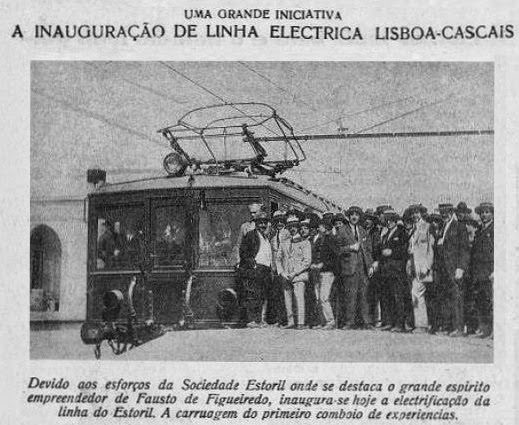
A major service improvement? Yes, but with unexpected consequences
The line passed by Carcavelos alongside an undersea communications cable installation of the Eastern Telegraph Company. Stray currents associated with electric traction caused interference in the cable linking Portugal with the Azores and the United States.
Six days after the inauguration, the electric service had to be suspended, and trains temporarily returned to steam traction. The problem was not definitively resolved until 22 December 1926, when electric train operation resumed.
Despite this troubled start, the Cascais line became a success story and a technical reference within Portugal. On 16 June 1944, its only extension opened: the 1.7 km branch from Cruz Quebrada to the Estádio Nacional.
The first national push
The good results on the Cascais line encouraged other Portuguese railway companies to study electrification of their main lines. The State also promoted its analysis on certain corridors, such as the Lisbon and Porto suburbs and the Norte line.
Electrification was presented as a way to reduce dependence on fossil fuels, which Portugal imported almost entirely. CP was the company that progressed most seriously and studied the use of 3,000 V direct current on the Sintra lines, the Lisbon contour and the Norte line.
To reinforce the studies a commission was created and the French engineer Marcel Japiot, then director of rolling stock and traction at the prestigious PLM company, was invited. A rolling stock procurement tender was also launched, which attracted considerable industrial interest.
However, negotiations with the electric utility CRGE did not secure a sufficiently low price per kilowatt-hour to guarantee the investment’s profitability. The economic crisis of the 1930s ultimately postponed the electrification projects.
The leap to 25 kV
In 1947, the so-called single concession was created. Except for Sociedade Estoril, the Portuguese railway companies were integrated into CP, which remained a private company, albeit with State participation.
The new situation opened the door to major modernisation projects. Electrification featured among the main planned interventions and, after several studies prepared by three different commissions, the programme was relaunched in 1955.
This time a different system was chosen: 25 kV 50 Hz single-phase alternating current. Compared with direct current, this solution allowed simpler and cheaper infrastructure, among other reasons, because it required fewer substations.
Work advanced rapidly. On 28 April 1957, the electrifications from Lisbon to Sintra and Carregado, as well as the Cintura line, entered service. The impact on suburban services was immediate, and traffic grew very quickly.
Electrification advanced in stages northwards and reached Porto in November 1966. The works included doubling a 19 km section between Chão de Maçãs–Fátima and Albergaria dos Doze. In 1967, the energisation of the sections between Porto–Campanhã, Porto–São Bento and São Romão was completed, complementing the major intervention on the Norte line.
Afterwards, a new period of interruption opened, conditioned by the economic crisis and the change of political regime.
Network expansion
With Portugal’s accession to the European Economic Community in 1986 and the country’s stabilisation, railway investment regained momentum. The network needed profound modernisation and electrification became part of virtually all major projects.
Since the mid-1990s, numerous sections of the Portuguese network have been electrified. As a result, electric traction has become the dominant system of the national railway.
The process has enabled connecting much of the main railway corridors under catenary, from Valença do Minho in the far north to Lagos and Vila Real de Santo António in the south. The electrification of the Algarve Line, which links both municipalities, entered service on 19 July.
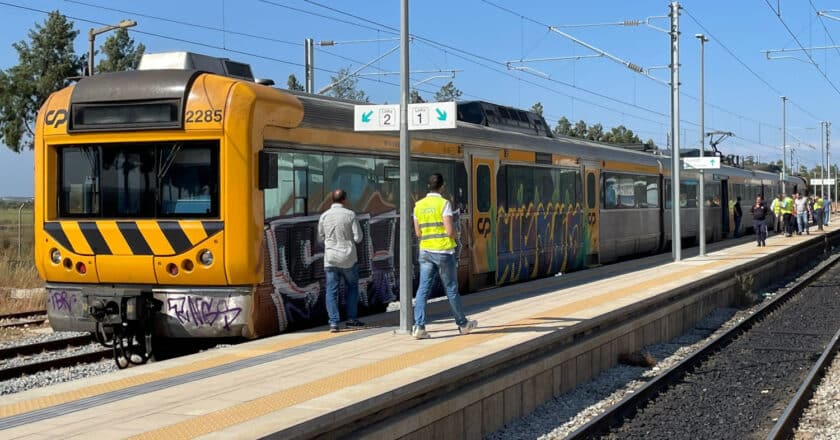
Expansion, however, is not yet finished. Modernisation projects on the Oeste and Douro lines propose new interventions, while the future high-speed line between Évora, Elvas and Badajoz represents the next major chapter in Portuguese railway electrification.
The end of the 1,500 V DC island
Although the entire electrified railway network is supplied at 25 kV 50 Hz AC, the Cascais line still retains the original direct current voltage, being the only Iberian-gauge line that uses 1,500 V. An exception that prevents interoperability with the rest of the network but which is being addressed through migration to 25 kV.
Infraestruturas de Portugal is working on replacing the original poles, catenary and substations with a new electrification that will allow the operation of new trains purchased from Alstom, improve efficiency and performance, and unify the voltage across the Portuguese railway network.
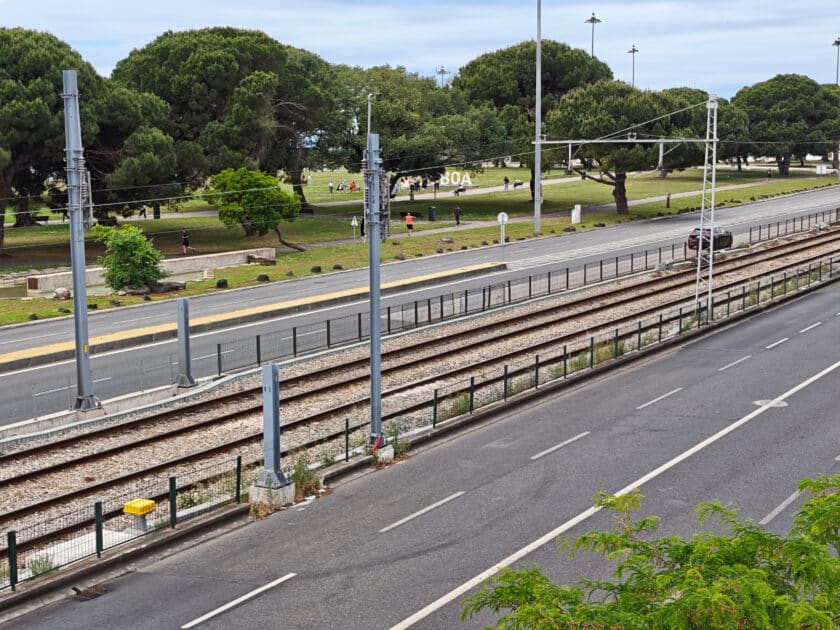
The adventure continues: electrification does not stop
The history of railway electrification in Portugal began as a response to tram competition and ended up completely transforming the national network. From the 1,500 V direct current of the Cascais line to the 25 kV 50 Hz of today’s main corridors, each stage has responded to the technical, economic and political needs of its time.
A century-old adventure, but still with many good chapters to write.