
The Spanish Minister for Transport and Sustainable Mobility, Óscar Puente, this morning presented in Madrid an ambitious plan to modernise Cercanías line C‑5, which links Móstoles-El Soto with Fuenlabrada and Humanes.
The project represents a total investment of 1.35 billion euros, of which Adif will contribute 650 million for infrastructure and Renfe 700 million for rolling stock and associated services.

Puente described the C‑5 as “the driving force of southern Madrid”, with more than 72 million passengers a year, accounting for 29% of all journeys on the Madrid Cercanías network, which handles around 250 million users annually.
The modernisation of the C‑5 responds to sustained growth in demand. The line requires a structural overhaul to boost capacity and reliability, as well as a step change in accessibility. The project features 28 key interventions that will increase capacity by 60%, equip the line with ERTMS Level 2 signalling and deliver 100% step-free access at both stations and trains. Puente stressed that, after five years of work (running through to 2031), the C‑5 will be “more capable, more punctual and fitted with Europe’s cutting-edge technology”.
Infrastructure works by Adif
Adif will deliver the 28 interventions in several phases: three schemes already under construction, five approved and awaiting tender, ten at design stage, seven with works out to tender and three with design contracts being tendered. Highlights include:
- Extending platforms by 40–50 metres at Embajadores, Laguna, Aluche, Maestra Justa Freire–Polideportivo Aluche and Las Águilas to accommodate 200‑metre trains.
- Extending headshunts by 200 metres.
- Building a new fully accessible station at Móstoles-El Soto.
- Replacing the current LZB system with ERTMS Level 2 to optimise line capacity.
- Installing BAB (bidirectional automatic block) throughout the route so trains can use either line in normal operation.
In addition, crossovers will be reconfigured to allow trains to switch tracks between Atocha and Móstoles at stations with interchanges to Metro de Madrid, making it easier to maintain connections during disruptions. Safety will also be enhanced for tunnel and underground-station evacuations, and a new siding complex will be built at Humanes alongside a maintenance depot in Móstoles for 200‑metre units. Fifteen of these schemes will be compatible with live traffic, minimising disruption to day‑to‑day services.
Rolling stock and service investment by Renfe
Renfe will allocate 600 million euros to purchase 35 new high‑capacity Stadler EMUs featuring automatic train operation, designed to meet European standards. These are the first 35 units of the 200‑metre‑long class 453, a double‑deck fleet conceived as the new flagship for Madrid Cercanías.
However, this stock may prove less than ideal for a high‑turnover radial line such as the C‑5, given that it has fewer doors per side than existing classes like the 465s and 452s; the number of doors (and the internal staircases) has a direct impact on boarding and alighting times.
A further 60 million euros will go into depots: 53.5 million for the new Móstoles base and the remainder for Humanes. In parallel, 40 million euros will fund replacement bus plans (special routes and EMT services) during blockades, to safeguard heavy public transport capacity in the south of Madrid.
Timeline and service blockades
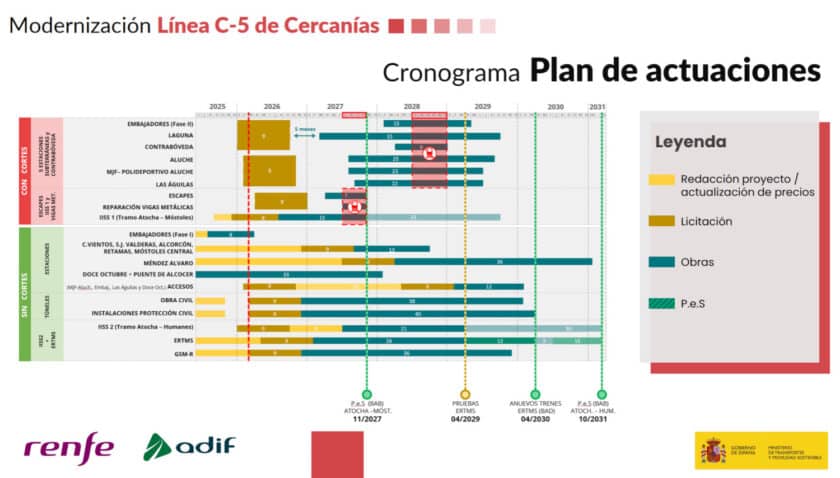
The programme runs through to October 2031, with several key milestones:
- December 2026: start of GSM‑R installation.
- February 2027: start of ERTMS Level 2 installation.
- July–October 2027: first service blockade between Atocha and Cuatro Vientos.
- November 2027: commissioning of BAB between Atocha and Fuenlabrada.
- July–December 2028: second service blockade between Atocha and Móstoles.
- April 2029: start of ERTMS testing.
- April 2030: new trains and ERTMS enter revenue service.
- First half of 2031: BAB goes live between Atocha and Humanes.
Institutional cooperation
Puente underlined the need for institutional loyalty, recalling that the deliberate decision to postpone the C‑5 upgrade was intended to avoid overlapping works with Madrid City Council’s A‑5 tunnelling scheme, scheduled to finish in January 2027.
He called on the Madrid Regional Transport Consortium (CRTM) to cooperate on alternative services during blockades, insisting that “the southern corridor must never be left without a powerful public transport offer”. The scheme bolsters the Madrid Cercanías Plan and aligns the network with European benchmarks for reliability and sustainability.