
Today is the third and final day of February’s rail strike, and Renfe passengers are bearing the brunt. While Ouigo and Iryo are sticking to their minimum-service diagrams, the Ministry of Transport scrapped minimum-service obligations for the state operator after a deal was signed with the majority unions.
A strike “called off”… only in part
On Monday, the Ministry of Transport and the unions SEMAF, UGT and CCOO reached an agreement to call off the stoppages planned for 9, 10 and 11 February. However, as Trenvista (and Trainvelling) reported at the time, CGT and SF were not party to that agreement and kept their strike notice in place.

Even so, the Ministry and Renfe announced the deal—and the “cancellation” of the strike—in triumphalist terms. So much so that the Secretary of State for Transport and Sustainable Mobility, José Antonio Santano, signed off the withdrawal of Renfe’s minimum-service requirements.
Cancellations and patchy comms
Despite CGT and SF being minority unions within Renfe (though not necessarily across rival operators), the strike has continued—and services have been cancelled across the network. During yesterday’s disruption, the operator attributed cancellations to “operational reasons”.
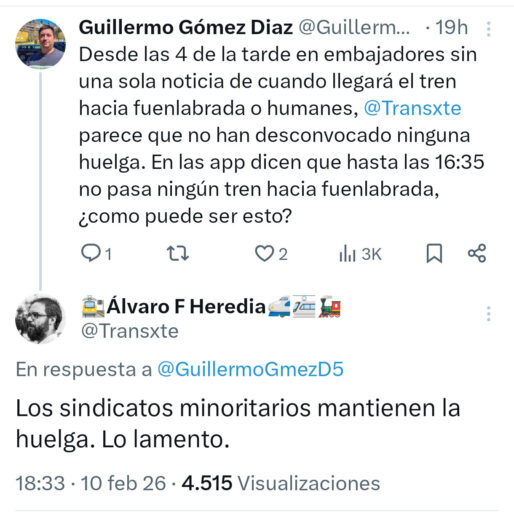
After complaints on social media, Renfe’s president, Álvaro Fernández Heredia, clarified that the minority unions were still pursuing industrial action.
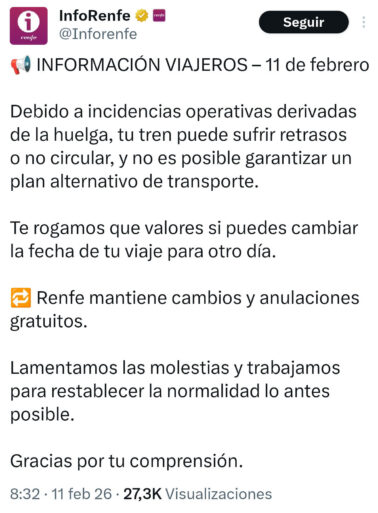
Renfe’s own service-information channel on X (InfoRenfe) did not begin warning of “operational incidents arising from the strike” until this morning.
With transparency lacking and passenger messaging inconsistent, there is still no clear overall picture of the strike’s impact; El Economista reported four Madrid–Barcelona/Figueres services suspended this morning.
Trust hit for the railway
With Spanish rail already facing a serious reputational crisis, this handling only deepens passenger mistrust—damaging confidence in the system, the public operator and the Ministry alike.
Where strike action remains live, it is better to err on the side of caution and retain minimum services, rather than upend the travel plans of passengers who end up unable to travel while a fundamental right is exercised.