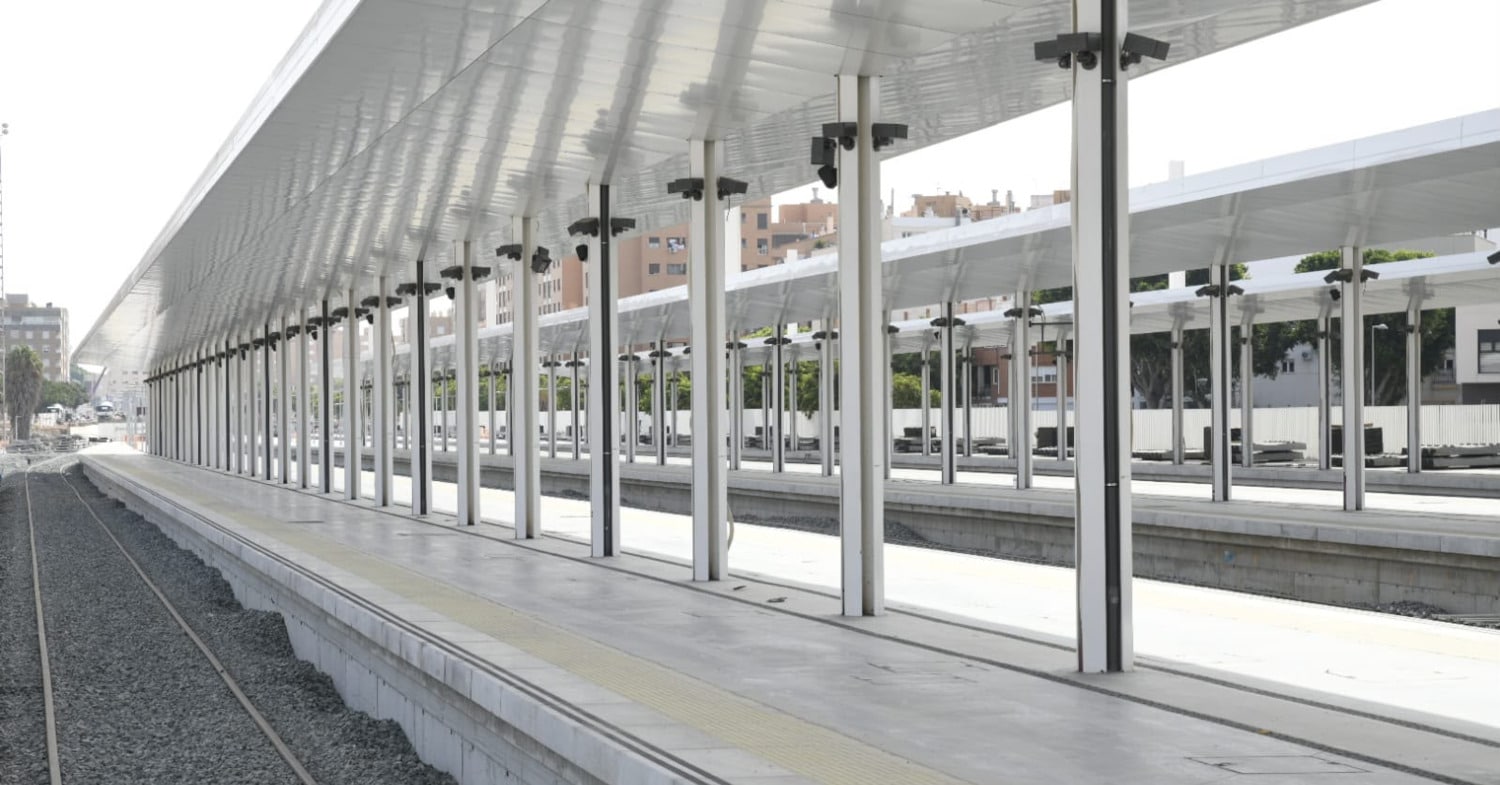
The Spanish minister of Transport and Sustainable Mobility, Óscar Puente, inspected the works on Almería’s new intermodal station and the city’s rail integration this morning, with both projects now in their final phase.
During the visit, which was also attended by the minister of the Presidency, Félix Bolaños, Puente stated that the works will enable the restoration of traffic on conventional line 410 linking Linares-Baeza with Almería once construction, testing and the requisite formalities are completed. At present, trains cannot proceed beyond Huércal.

The future station will comprise a main building of 2,775 m² with six platform tracks, alongside a bus terminal of 2,250 m² with 26 bays. The complex will include an underground car park for 400 vehicles and will replace the old classical station.
The urban integration scheme includes a 1.9 km tunnel and a double-track alignment: one standard-gauge track and one mixed-gauge track using third rail. Of the planned 8.7 km of track, more than two kilometres have already been installed. Investment for this second phase amounts to €235 million.
Adif AV has executed more than €2.7 billion of the €3.6 billion budgeted for the Murcia–Almería high-speed line (LAV), with the formation complete or under construction across all sections. Moreover, this line will be the first to feature Adif’s aerotraviesas (aerodynamic sleepers), which allow speeds of up to 350 km/h without inducing ballast flight.