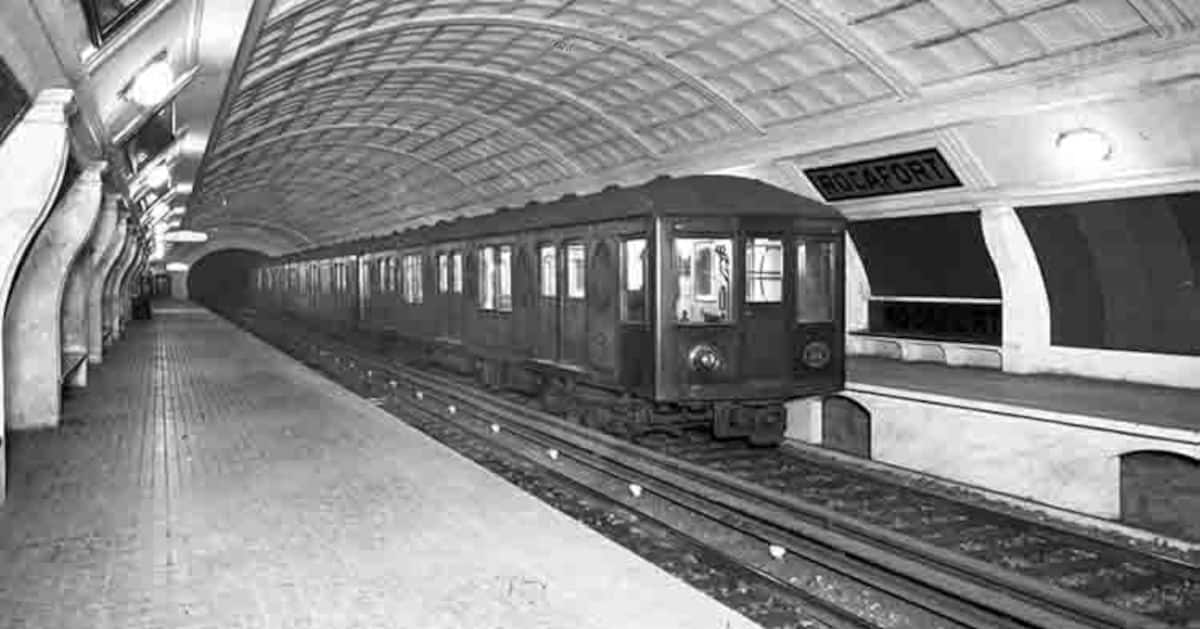
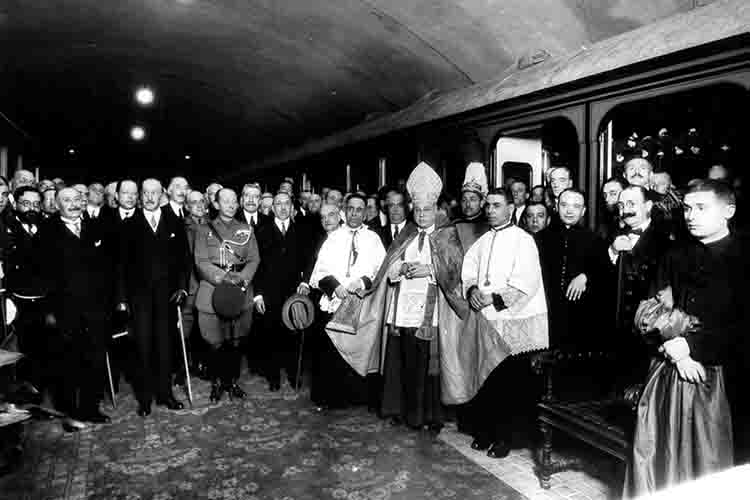
Today, 10 June 2026, Barcelona metro Line 1 celebrates its centenary. Originally opened as the Transversal Metro on 10 June 1926, the line remains unique within the network for its 1,674 mm Spanish gauge.
This technical characteristic makes it one of the widest-gauge metro lines globally, surpassed only marginally by certain systems using Indian gauge.

Independent origins from the Gran Metro
Ferrocarril Metropolitano de Barcelona (FMB), established in 1920 under Banco de Vizcaya control, conceived the route as a cross-city underground axis linking the city’s main railway termini. To ensure compatibility with the Norte and MZA main line networks, FMB adopted Spanish broad gauge.
Conversely, the Gran Metropolitano de Barcelona (builder of today’s L3) selected standard gauge (1,435 mm).
Line 1 thus remains a vestige of the former Spanish gauge, formally superseded in 1955 by the unified Iberian gauge (1,668 mm). While Spain’s main network (RFIG) has progressively migrated away from this gauge, TMB continues to operate it on this urban railway.
The centenary section corresponds to the original stretch between Catalunya and the former Bordeta station, located between Mercat Nou and Santa Eulàlia.
Historical connection with the national network
The adoption of Spanish gauge enabled a physical interface between L1 and the national rail network (now RFIG) at Catalunya station. This connection allowed rolling stock transfers, though usage was limited, and the link was dismantled in recent years.
No other metro line in Spain features such interoperability, as most are built to standard or metre gauge and lack physical connections to the main line network.
Milestones in the history of Line 1
| Year | Milestone |
|---|---|
| 1926 | The Transversal Metro line opens on 10 June with 9 stations, a length of 4,063 metres and a track gauge of 1,674 mm. |
| 1932 | Extension to the Arc de Triomf. |
| 1955 | Connection to the L4 at Urquinaona. |
| 1961 | Merger of companies (FMB + Gran Metro). It came to be known as Line I. |
| 1982 | Renumbering as L1 under the new map. |
| 1989 | Extension southwards to Bellvitge Hospital (19 October). |
| 1992 | Extension northwards to Fondo (Santa Coloma). |
| 2016 | Replacement of the third rail with a rigid catenary. |
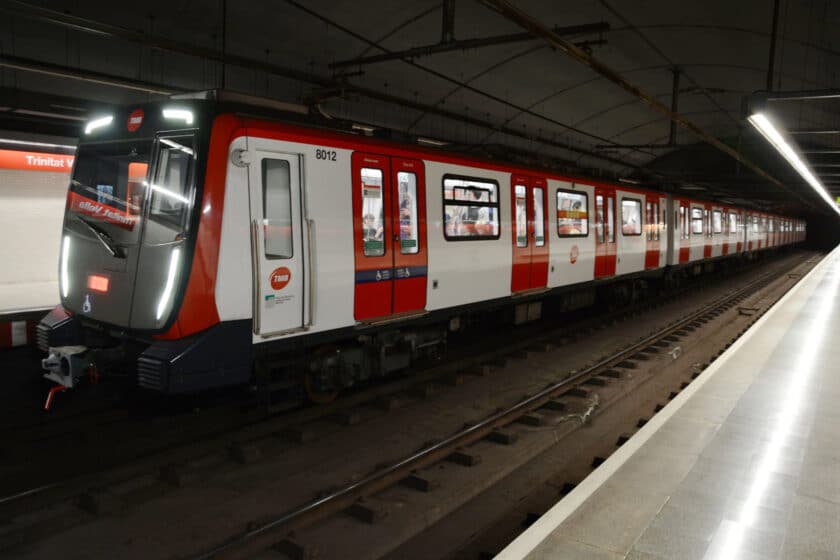
| The last 20 years | Modernisation of stations, with 86% now accessible to people with reduced mobility (26 out of 30), and the introduction of the 8000 series trains. |
Line 1 currently has 30 stations and runs for 20.7 km between Hospital de Bellvitge and Fondo.
Highest ridership corridor
L1 is both the longest and most heavily used line in the Barcelona metro network. Of the 469 million passengers recorded in 2024, 125 million (27%) were carried on this route.
The fleet comprises 6000 and 8000 series trains; the 4000 series was withdrawn in 2024.
Future expansion
Authorities plan extensions valued at €788 million:
- Northward to Badalona (over 4 km, five new stations; €547.2 million).
- Southward to El Prat Estació (€241 million).
A century underground
The centenary of L1 highlights Barcelona’s urban and transport evolution. Its origin as a रेलवे interconnector and its retention of Spanish gauge make it a technically distinctive corridor, both within the city and internationally.
With a century of operation behind it, Line 1 continues to evolve, reinforcing its role as the backbone of Barcelona’s metro network while preserving a unique engineering legacy.