
Vibrations on high-speed trains are increasingly worrying passengers, especially as they have intensified due to the growing number of trains running on the same tracks. The Adamuz derailment and drivers’ complaints about insufficient maintenance have amplified fears that these vibrations might cause a derailment.
In this On Track feature, we’ll look at what these vibrations are, how dangerous they really are, and the maintenance challenges facing Adif.

What are vibrations?
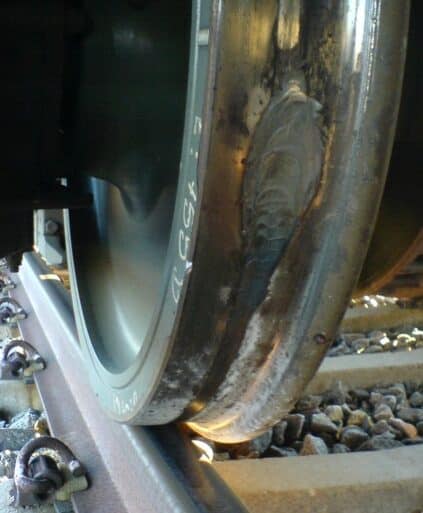
Train wheels have a truncated cone shape, with a flange at the base. This flange guides the wheels along the tracks, while the so-called tread (the outer surface of the cone) supports the weight of the train.
In perfect conditions (tread and rails without wear), there should be no vibrations. It would be like driving on a newly asphalted road with new tyres.
However, vibrations in trains occur when the rails (or wheels) have small irregularities.
Compared to the road, they occur when the asphalt has cracks or is poorly sealed, causing the vehicle to vibrate.
In the railway, we have two types of oscillatory movements:
- Vertical. These are generally abrupt up and down movements caused by imperfections in the rail surface or wheel tread (known as “wheel flats”). They are damped by the primary and secondary suspensions and are felt most when these suspensions are absent or fail. These vertical oscillations are the “bumps”.
- Lateral. These oscillations are known as “loop motion”. It is noticeable at high speeds. They are compensated by a special type of damper called anti-loop, which in Spain is compulsory on trains over 160 km/h.
These vibrations are measured with specific equipment on auscultation trains. In addition, many of the Spanish high-speed trains are equipped with these devices.
Why do they occur?
Basically, they are caused by wear and tear on the rails due to use. The more a track is used, the more it wears. Specifically, the most common types of damage are:
- Surface ripples: waves of tenths of a mm due to repeated wear, which cause the wheel to “bounce”. Solution: Grinding of the rail or replacement of badly worn parts.
- Geometric irregularities: slight loss of levelling or alignment, amplified at high speed. Solution: ballast tamping.
- Fatigued welds: worn or misaligned joints between rails (usually termite welds). They create rhythmic “bumps”. This is solved by replacing the weld with a new one.
- Point wear: loose, misaligned or micro-cracked areas resulting in dry knocks.
All these irregularities can be fixed with preventive maintenance and also with comfort-based corrective maintenance.
Train vibrations and safety
Let’s get down to the nitty-gritty: are vibrating trains unsafe?
The short answer is NO.
Vibrations on regular trains do not cause derailments; trains are designed to withstand them.
As I explained earlier, many of the high-speed trains running in Spain detect and record vibrations. If these movements exceed a threshold where they can be dangerous, warnings are activated and, where appropriate, the train itself automatically slows down.
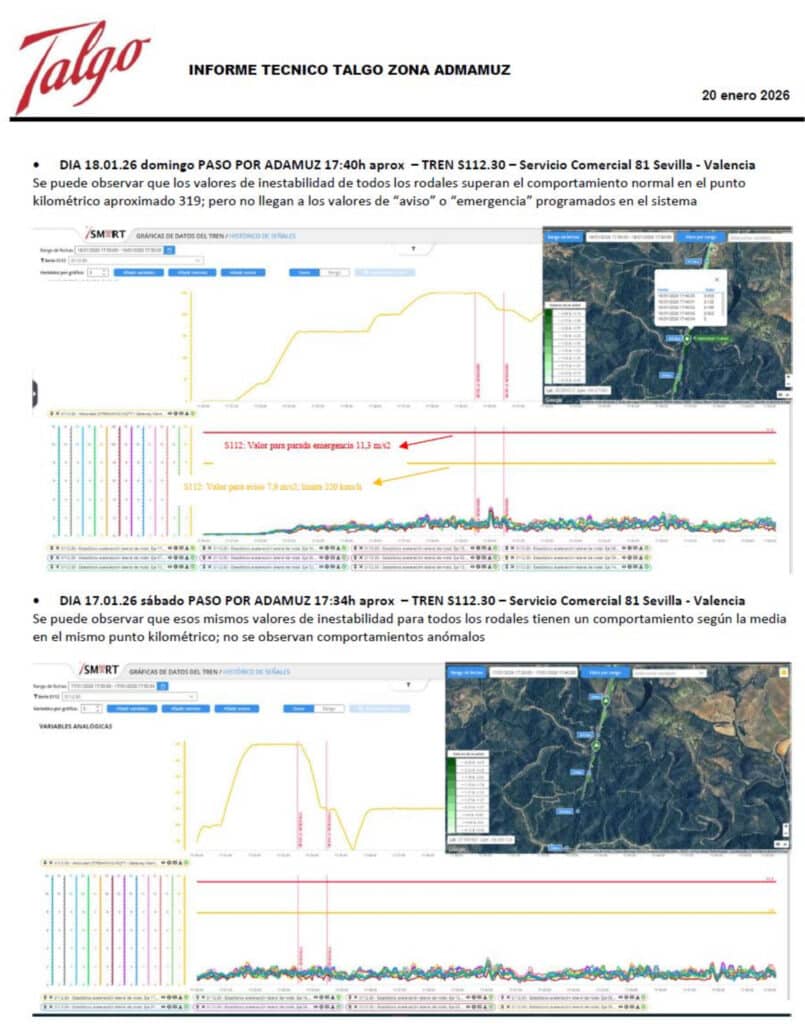
In addition, Adif’s auscultator trains (vehicles with equipment that study the entire infrastructure) check the track in more detail to determine whether it is safe or unsafe. Particularly if train drivers report damage they consider to be dangerous.
When the threshold that poses a safety risk is exceeded, a Temporary Speed Limit is immediately set and lifted only when the affected point is fixed. Reducing the speed returns to the safety thresholds.
To continue with the analogy, vibrations in trains are like the imperfections on a motorway. You can go at 120 km/h, but the “rattling” is annoying. The problem comes when those imperfections are very big and going that fast is a danger – you certainly wouldn’t go 120 km/h on a goat track!
In conclusion, vibrations on trains are not dangerous. They are uncomfortable, they can be scary, but Adif checks the tracks to make them safe. Even so, VIBRATIONS SHOULD NOT EXIST.
Just because they are not dangerous does not mean we have to swallow them.
In other countries, there are high-speed lines with more traffic on which trains do not suffer from these vibrations. In addition, they cause the wear and tear of tracks and trains to increase, as described below.
Safety yes, comfort if necessary
Adif Alta Velocidad had a budget of 437 million euros in 2025 to maintain the high-speed network. This is equivalent to 110,000 euros per kilometre. It is a low amount compared to other countries.
This means that Adif has to do a lot with little. And what does it prioritise? Safety. And also the digitalisation that makes railways more efficient and safer.
On a road, what is more important: that the road surface is smooth or that the bridges stay in place? It is better that there are a few small bumps, but that the bridge does not fall. Due to budget constraints, vibrations on trains are put on the back burner.
Therefore, with the budget it has, Adif has to focus on getting the trains to their destination, although comfort depends largely on the train’s shock absorbers. It is not the same to go on a 106 (the infamous Avril) as on a 100 series; despite its age, it has very good shock absorbers, as does the 108 series of Ouigo.
Has expenditure on maintenance increased?
Yes, it has. But with small print.
In 2017, €260 million was spent to maintain 3,130 km (€83,000/km) of high-speed rail. In 2025, €437 million has been spent to maintain 4,000 km (€110,000/km). Nominally, this is an increase of 33%.
But now comes the small print. With inflation, €83,000 in 2017 equals €105,000 in 2025, so the real increase has been 5%.
But, of course, traffic (and wear) has not increased by only 5%.
What are France and Italy doing?
Both countries have smaller high-speed networks than Spain (France 2,800 km, Italy 1,200 km and Spain 4,000 km), but with much more traffic (more than 130 a day between Rome and Milan compared to 58 between Madrid and Barcelona). And they do not suffer from train vibration problems.
In these two countries, however, they do attach importance to comfort and apply preventive maintenance measures. They act before it happens.
Figures on maintenance expenditure are unclear, as neither SNCF Réseau (French infrastructure manager) nor RFI (Italian) separate the accounts of conventional and high-speed networks.
In both cases, expenditure is estimated at around €140,000/km, which is higher than in Spain.
Vibrations damage trains and tracks
Vibrations on continuous trains are not dangerous. But they are very damaging to trains. They accelerate the wear of rolling elements and start a vicious circle in which trains suffer from wear and tear that further wears the track.
The section of the Madrid-Barcelona high-speed line in the worst condition is the one from Madrid to Calatayud. According to a report by Tarvia, the maintenance company for the 106 series trains (Talgo’s Avril trains), these vibrations caused problems in the bogies of the tractor heads. They ended up cracked and banned from the line.
Final conclusion: it is safe to travel on Spain’s high-speed network. Vibrations on trains are not a safety problem, but more needs to be spent on preventive maintenance and on improving comfort. Greater comfort gives a greater sense of safety and generates fewer issues in rolling stock.