
The Minister of Transport and Sustainable Mobility, Óscar Puente, appeared before the media this Friday to update on the derailment that occurred on Monday in Adamuz, on the Guadalmez–Córdoba section of the Madrid–Seville high‑speed line.
Joined by Adif president Pedro Marco de la Peña and Secretary of State for Infrastructure José Antonio Santano, Puente has now given evidence for the second time, this time following the publication of a provisional report by the CIAF, which points to a rail fracture occurring prior to or at the same time as the passage of the Iryo train as the main working hypothesis.

Throughout their statements and responses to journalists, the three officials mainly presented a large volume of highly relevant data, summarised here. This information addresses the key questions raised this week and aims to counter false reports circulating online.
One of the most significant points highlighted is that rail fractures, the main suspected cause of the derailment, are a relatively common occurrence on railways. However, they rarely lead to accidents involving passenger trains. According to their remarks, the European Union Agency for Railways (ERA) records around 3,000 rail fractures per year, excluding countries that do not report such data.
This has to be set against another issue Trenvista covered on Thursday: faults in new aluminothermic welds are not uncommon. Rail fractures at welds can be extremely difficult to detect, as they often start as micro‑cracks invisible without costly, specialised inspection technologies.
Renewal contracts on the affected section
Puente detailed the two procurement files for works carried out on the Guadalmez–Córdoba stretch, part of the full renewal of the Madrid–Seville high‑speed line, which involved a total investment of 780 million euros.
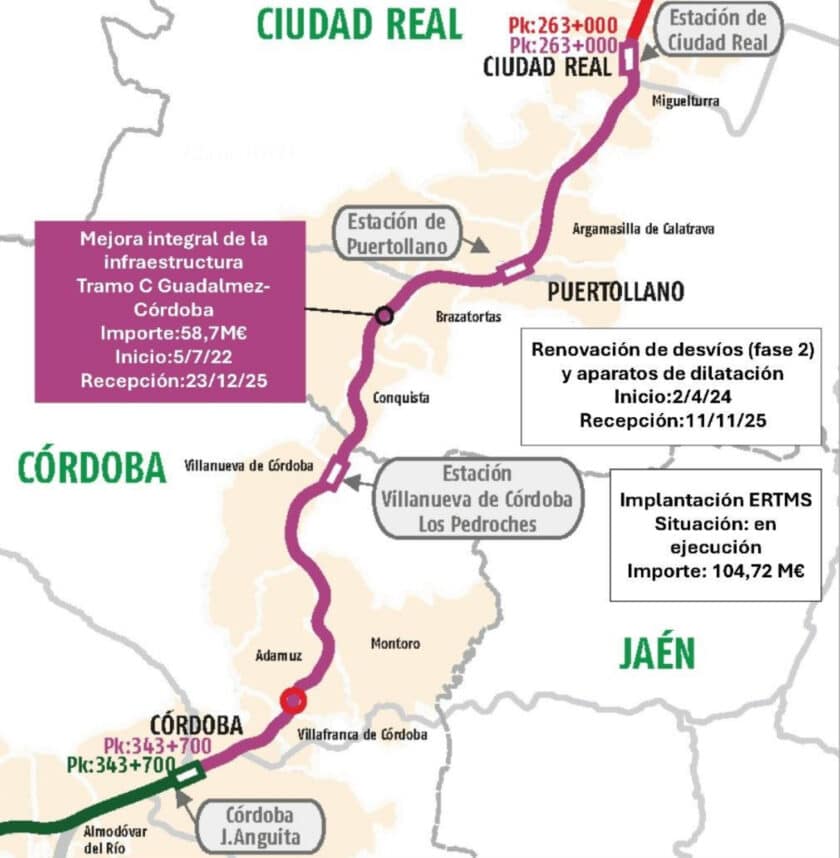
The first contract covered the comprehensive improvement of the infrastructure (formation, slopes, drainage, etc.), awarded to the UTE (joint venture) Ferrovial, OHLA, FCC and Azvi for 49 million euros (plus a 6‑million‑euro modification to maintain compatibility with traffic). This UTE submitted the best technical bid and the second‑best economic offer.
The second contract, for the renewal of points and crossings and PAET equipment (including those at Adamuz station, which entered service on 20 June 2025), amounted to 26.86 million euros, again awarded to the same UTE, which scored best both technically and economically.
A third contract, currently underway, covers the installation of ERTMS (the safety system that will replace LZB) and is valued at 104.72 million euros.
Puente defended the technical solvency of these “blue‑chip” Spanish public‑works companies, all of which hold the required technical certifications.
Quality checks on superstructure and welds
Regarding the superstructure (rails, sleepers and ballast), Pedro Marco stated that regulatory quality controls were applied, including ultrasonic testing on all 114 welds in the section (100% passed, with visual inspection, liquid‑penetrant testing and geometric checks).
The weld involved in the incident (joining an existing rail with a new one) was signed off by an accredited works supervisor. In addition, engineering firm Ayesa, contracted to oversee construction quality, independently checked 30% of the welds (36 in total) using a second inspection team; all were deemed fit for service.
he rail was manufactured in Spain by ArcelorMittal (España), with full traceability of the steel batch and rail stamping. Each weld also has detailed traceability records.
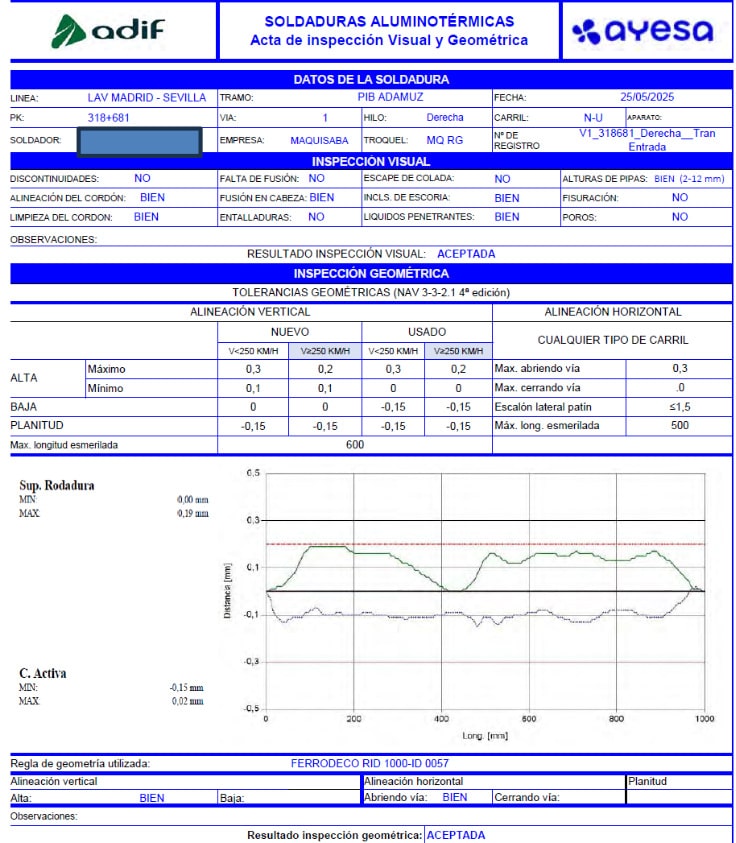
These tests incorporate recommendations issued previously by the CIAF (Spain’s railway accident research commission) after incidents such as the 2017 freight train accident.
Intensive maintenance: inspections beyond the norm
Puente stressed that this section has been subject to more inspections than usual, under Adif’s “safety management system”, overseen by the State Railway Safety Agency and the ERA, and due to ongoing works carried out while the line remains in service.
On ballast tamping, the Minister said that 13 tampings were carried out in a 10‑km stretch in both directions during 2025, the last on 6 November. As for dynamic track inspections, the following runs were completed last year, five of them after the renewal works:
- 4 March.
- 24 March.
- 21 April.
- 20 May (pre-work).
- 26 June (6 days after the entry into service of the new turnouts).
- 8 September.
- 13 October.
- 15 October.
- 21 November.
Regarding geometric inspections, four runs were carried out on this section in 2025, half of them after the renewal works:
- 24 March.
- 21 April.
- 8 September.
- 13 October.
uente also noted that the last ultrasonic rail inspection on this stretch was on 10 November 2025 and that the last visual inspection of the points and crossings in this section took place on 7 January of this year.
Pedro Marco underlined that inspections on this section are more frequent than the network average, due to an “excess of caution” in view of the risks posed by works carried out while the line remains in operation. Some of these night‑time works include the removal and re‑installation of points and crossings or the fitting of Eurobalises for ERTMS.
Four incidences reported in the last four months
Óscar Puente reported that over the last four months train drivers have logged four incidents on this Guadalmez–Córdoba section:
- Ballast displacement (30 October).
- Collision with an animal (31 October).
- Falling component from a train ( (25 November).
- Pantograph disengagement (26 November).
Data from preceding trains
The Renfe trains that previously ran over the section are equipped with vibration sensors that trigger alerts and automatically reduce speed if thresholds that could compromise safety are exceeded.
Analysis carried out by Talgo, the train manufacturer and maintainer, showed progressively increasing lateral accelerations. While these indicate that something abnormal is happening, they did not reach the “yellow level” threshold. However, it has not yet been established whether these vibrations coincide with the accident location.
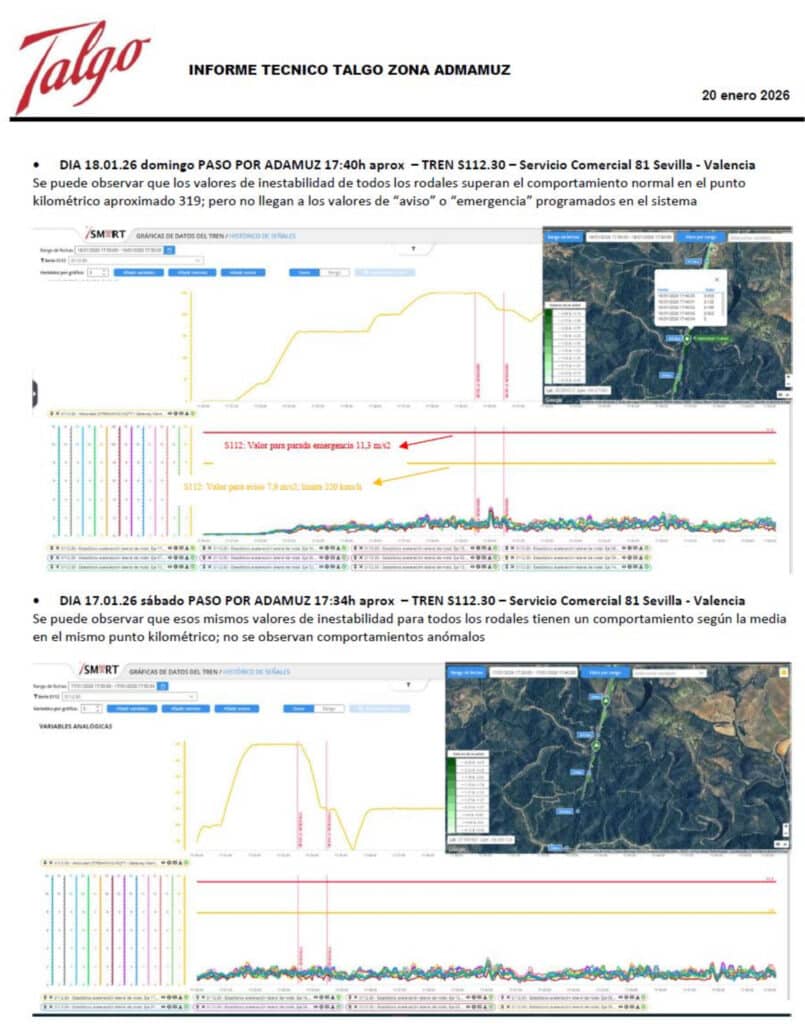
Analysis carried out by Talgo, the train manufacturer and maintainer, showed progressively increasing lateral accelerations. While these indicate that something abnormal is happening, they did not reach the “yellow level” threshold. However, it has not yet been established whether these vibrations coincide with the accident location.
At present, the hypothetical rail fracture is only evident from marks that may have been left on the wheel tyres.
As a precautionary measure, Adif will identify batches of similar rails to carry out special inspections.
The investigation by the CIAF and the judicial authorities must continue with the analysis of all recovered material, the documentation to be received from operators and Adif, and the established protocols, in order to reach robust conclusions.