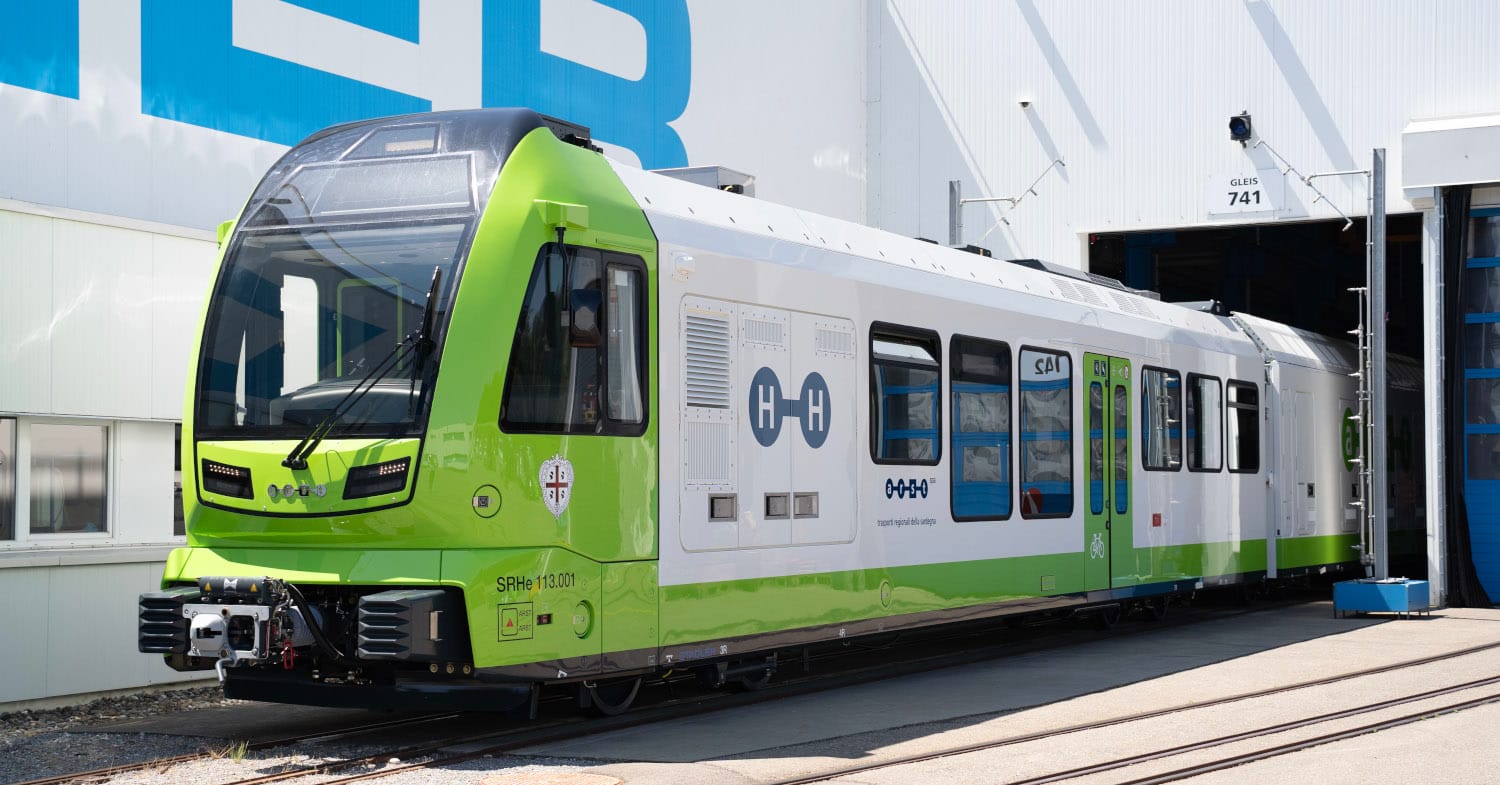
Stadler and Sardinian transport operator ARST officially presented on Thursday in Erlen, Switzerland, the world’s first hydrogen trainset designed specifically for revenue service on narrow-gauge lines. The ten vehicles ordered by ARST are scheduled to enter service in 2028 on routes linking Alghero Airport with Mamuntanas, Sassari with Alghero, and Sassari with Sorso.
The trainset employs a fuel-cell propulsion system with hydrogen stored aboard a dedicated intermediate vehicle — designated the Power Pack — which converts hydrogen into electricity for traction and battery recharging. The hydrogen used will be produced entirely from solar energy, delivering a net-zero emissions chain from power generation through to traction.

Compared with the ten diesel units being replaced, the fleet will eliminate over 2,100 tonnes of CO₂ per year. The design incorporates lightweight materials to comply with the stringent axle-load restrictions inherent to Italian narrow-gauge infrastructure, as well as low-platform boarding and wide panoramic windows.
The framework agreement signed in 2023 forms part of an Italian Ministry of Infrastructure programme to decarbonise narrow-gauge railways. Two further operators are involved in the scheme: Ferrovie della Calabria, with nine trainsets under construction, and Ferrovia Circumetnea in Sicily, with two units on order.
While this marks the first hydrogen trainset purpose-built for revenue service on metre-gauge lines, mention must be made of FEVE’s Fabiolo. In 2011, the now-defunct Spanish narrow-gauge operator completed the conversion of a retired Class 3400 unit to hydrogen propulsion. The project was, however, subsequently abandoned.