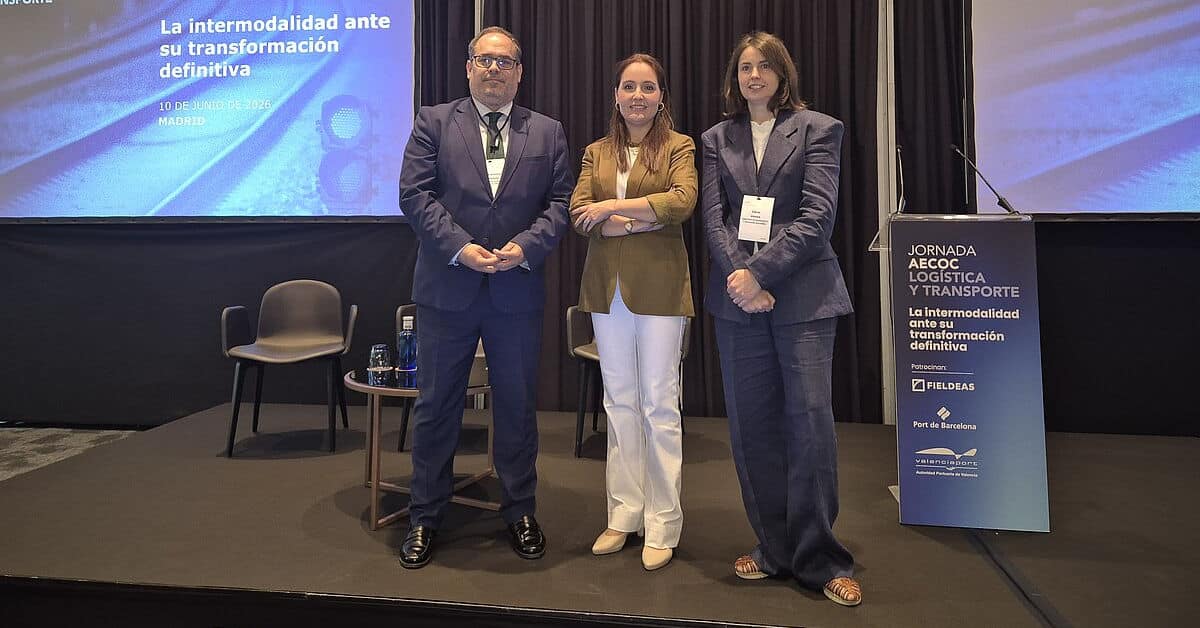
The Office of the Atlantic Corridor Commissioner and AECOC, one of Spain’s largest business associations, have presented the Intermodal Transport Plan for the FMCG sector 2026, developed with technical support from Ineco. The study updates the analysis carried out a decade ago and establishes a roadmap to increase rail’s modal share in a sector worth €843bn and employing 13% of the workforce.
The key innovation is the “Master Train” concept, an operational standard translating shippers’ requirements into five pillars:

- Reliability: Ensuring regular services and fixed paths with high punctuality.
- Competitiveness: Promoting multi-client models to achieve economies of scale.
- Robustness: Providing sufficient capacity and frequency to handle high turnover.
- Sustainability: Acting as a key lever for corporate decarbonisation targets.
- Transparency: Underpinned by digital tools enabling real-time traceability.
Rather than a specific service, it is conceived as a benchmark model to align stakeholders across the system.
The report notes that, despite broad recognition of rail’s potential, its uptake remains limited. To address this, it sets out ten recommendations, including improving punctuality, increasing service frequency, implementing scheduled services with allocated paths, fostering multi-client schemes, and strengthening digitalisation and sectoral coordination.
According to Commissioner José Antonio Sebastián, the aim is to match road transport in reliability and competitiveness, positioning rail as the backbone of the logistics chain.