
Transport and Sustainable Mobility Minister Óscar Puente has completed a test run between Stadler’s depot in Albacete and Aranjuez aboard one of the first five units of the class 453 series destined for the Madrid Cercanías network.
The units are scheduled to enter revenue service by late summer, once type approval has been granted, commercial simulations completed, trials under various operating conditions concluded, and drivers trained.

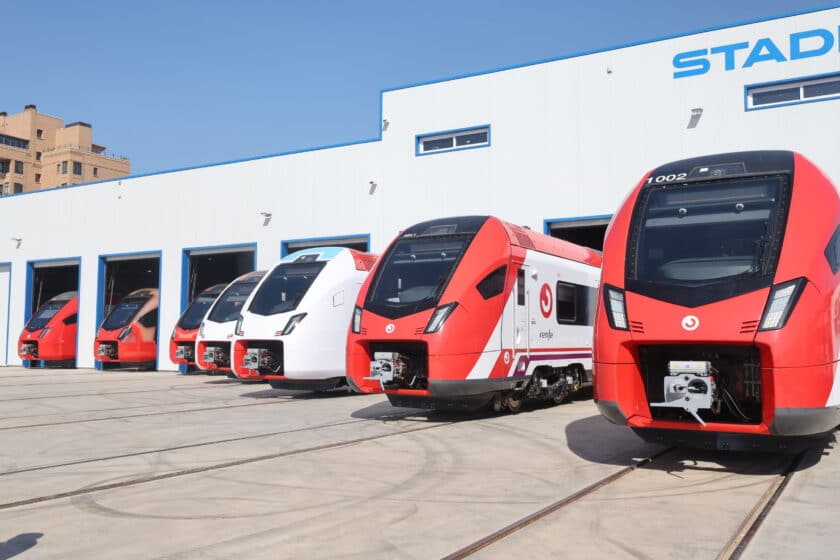
The new trains, built by Stadler at its Albuixech plant, form part of a 79-unit contract signed between Renfe and the Swiss manufacturer worth €1.306 billion. Following delivery of the first five units — three T100 four-car, 100-metre sets and two T200 eight-car, 200-metre sets — deliveries will continue on a monthly basis until nine T100s and eight T200s have been handed over before the end of 2026, with the remainder of the fleet joining progressively thereafter.
High capacity across single- and double-deck configurations
The T100 offers up to 912 seats, whilst the T200 accommodates 1,884 passengers — a 20 per cent increase over the capacity of the rolling stock currently in service. Both variants combine low-floor coaches with double-deck vehicles and are designed for operational flexibility: the T100 can be lengthened from four to five cars (T120 configuration), whilst the T200 is compatible with formations of up to 10 cars (T240) or can be reduced to a six-car, 160-metre consist.
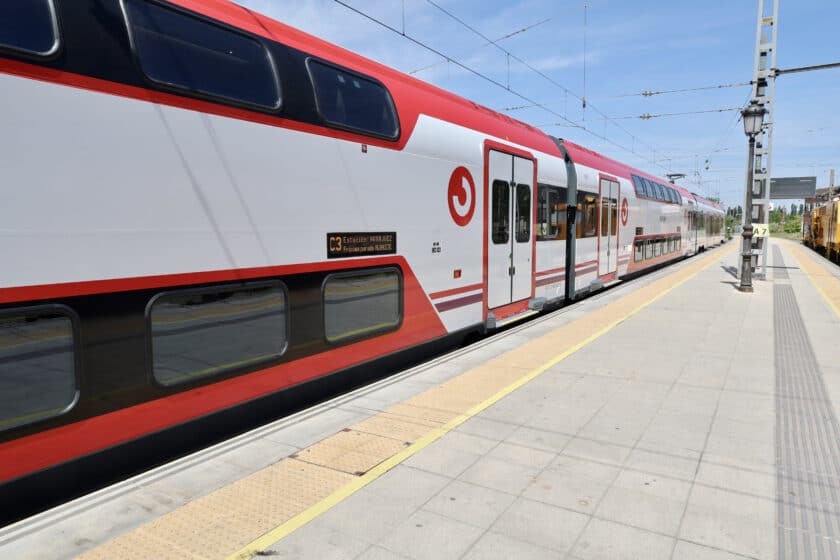
In their maximum formation, the T200s become the longest trains in Renfe’s fleet as single compositions, with four low-floor coaches and four double-deck vehicles.
The new units will operate on all lines of the Madrid Cercanías network except the C9 — a commuter rail system that carries more than 730,000 passengers daily and accounts for 55 per cent of all collective public transport journeys in Spain. Pending official confirmation, the C3 line is expected to be the first to receive the new trains, as a maintenance depot capable of handling 200-metre sets is due to open at Aranjuez within the coming months. Entry into service will also allow the withdrawal of the oldest rolling stock on the network, namely the class 446 and class 450 units.
Accessibility, comfort and on-board technology
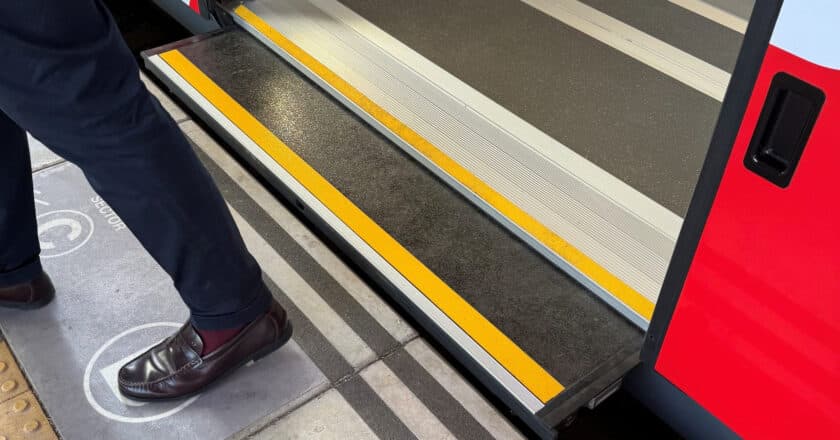
Beyond capacity, the new Stadler trains incorporate significant advances in accessibility. All single-deck coaches — half the consist — feature platform-level boarding, eliminating steps at six of the ten doorways on the T100 and at twelve of the twenty on the T200. In addition to facilitating access for all passengers, this will reduce dwell times at stations. The trains also feature dedicated spaces for passengers with reduced mobility, multi-purpose areas for bicycles — up to six on the T100 and eighteen on the T200 — and buggy spaces.
On the equipment front, the units are fitted with USB charging points and power sockets at seats, full-coverage CCTV, LED lighting, energy-efficient air conditioning, and a modern passenger information system. They are built to Iberian gauge and have a maximum operating speed of 140 km/h.
The largest fleet renewal in two decades
The procurement of the Stadler Cercanías Madrid trains forms part of Renfe’s rolling stock renewal programme, endowed with approximately €3.5 billion across the national network. It represents the first major fleet renewal for the Cercanías commuter services in nearly twenty years.