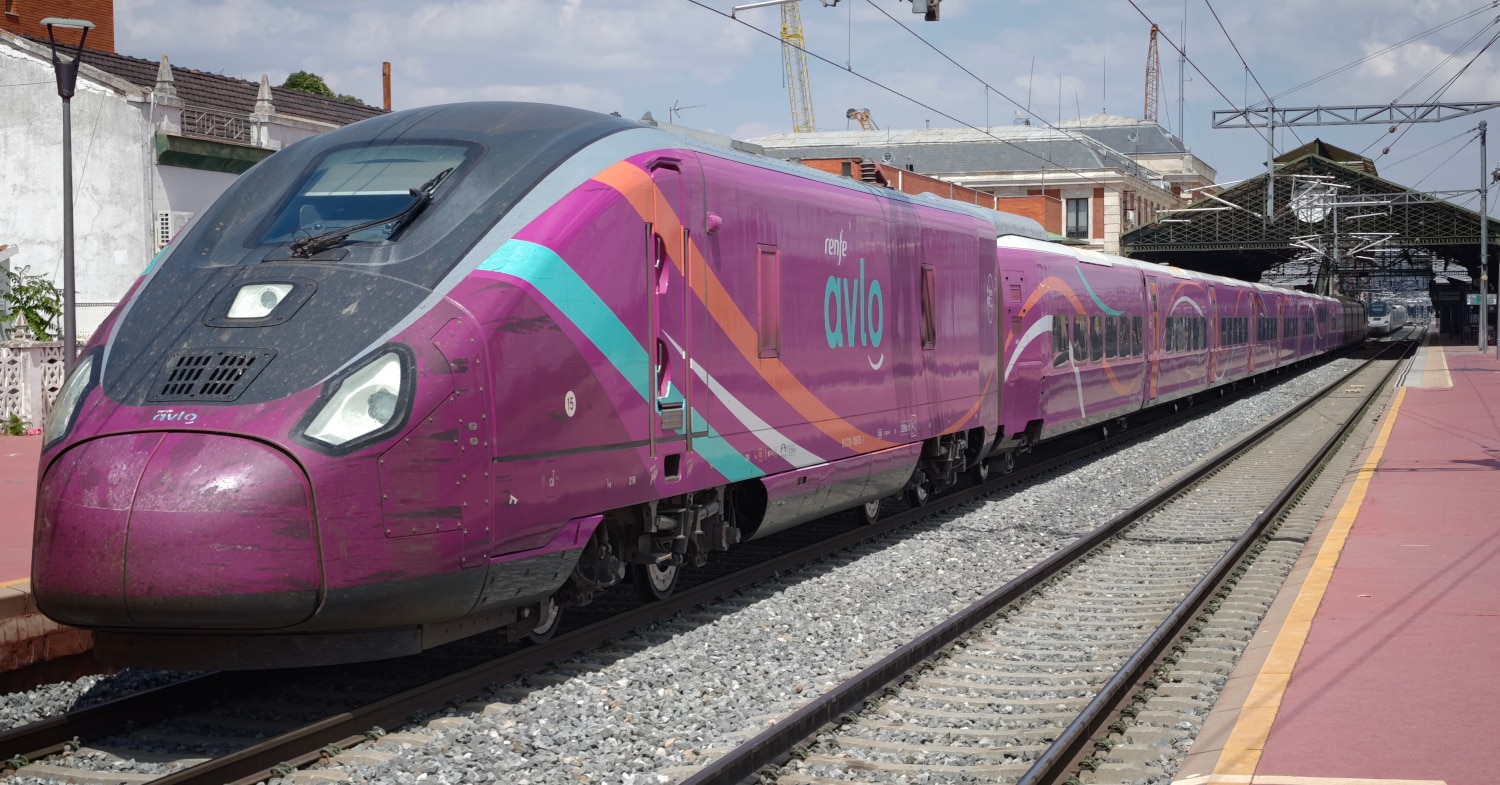
Renfe and the Spanish Railway Drivers’ Union (SEMAF) met this morning, with Renfe’s senior management present, to go through in detail the file on cracks in the bogies of the power cars of the fixed-gauge Class 106 trains.
The problem, which since July 2025 has required exhaustive monitoring of these components, led to two units being withdrawn from service in August.

A year of ongoing information exchange
This is not the first time the two sides have discussed the matter. Since the first signs of cracks in the bogie frames appeared more than a year ago, Renfe says it has kept SEMAF informed through several working groups and has relayed the latest cases detected on trains 106.011 and 106.015 without delay.
The union sees things differently: it has just formally demanded a detailed report on what measures are actually being applied and has called for the State Railway Safety Agency (AESF) to intervene, on the grounds that the current preventive plan is not delivering the expected results.
Fracture mechanics studies
One of the tests Renfe has been carrying out on these bogies is fracture mechanics and crack propagation analysis.
Fracture mechanics is the discipline that calculates how a material behaves once it already has a crack: it measures the stress the component can withstand at the crack tip and estimates the crack size at which the material would cease to resist and would fail.
On that basis, crack propagation tests reproduce in the laboratory the load cycles a bogie experiences in service — braking, curves, track irregularities — to see how fast a real crack would grow under those conditions. Using that model, Renfe and Talgo engineers have calculated that, once visible, a crack would need to propagate 38,000 km to reach a size that compromises the component’s strength, even under the most demanding track scenario simulated.
Magnetic particle inspection: seeing what the eye cannot detect
The other pillar of the control regime is a non-destructive test called magnetic particle inspection. The technique involves magnetising the metal component and applying a powder or liquid containing ferromagnetic particles. If there is a discontinuity — an incipient crack, for example — the magnetic field distorts at that point and the particles accumulate there, outlining the defect even if it lies just below the surface and is invisible to the naked eye or to touch.
This is the same principle already used to inspect railway axles, and explains how Renfe has been able to detect cracks before they became perceptible in a conventional visual inspection.
The company has decided to intensify these tests: inspections, previously carried out every 10,000 km, are now repeated every 5,000 km, i.e. roughly twice a week instead of once. This is combined with a more conservative criterion, based on accumulated bogie wear, which has led to the preventive withdrawal of around 16 components that showed no cracks or signs of failure.
The solution: bogie replacement
While the root causes are being finalised, Renfe has already set the remedy in motion: an agreement with Talgo, valued at €132 million, to convert the 15 fixed-gauge Class 106 trains into variable-gauge units, which entails replacing the current bogies with more robust ones capable of running on both Iberian and international gauge.
The process, which also involves replacing the wheelsets, will take 37 months. Until then, enhanced monitoring will remain the main safety barrier.
Renfe has passed this entire history to the AESF and has asked Talgo to speed up its analyses to pinpoint the exact origin of the problem and provide a definitive solution. The manufacturer had attributed the cracks to the condition of the Madrid–Calatayud section of the Barcelona high-speed line. However, the two trains now affected were not in service on that corridor. For the time being, Renfe has not announced any penalties, and it is increasingly clear that this is a manufacturing defect.
The operator insists that passenger and staff safety “has never been at risk”, although SEMAF’s call for the rail regulator to intervene makes it clear that, behind closed doors, trust between the parties is not yet fully restored.