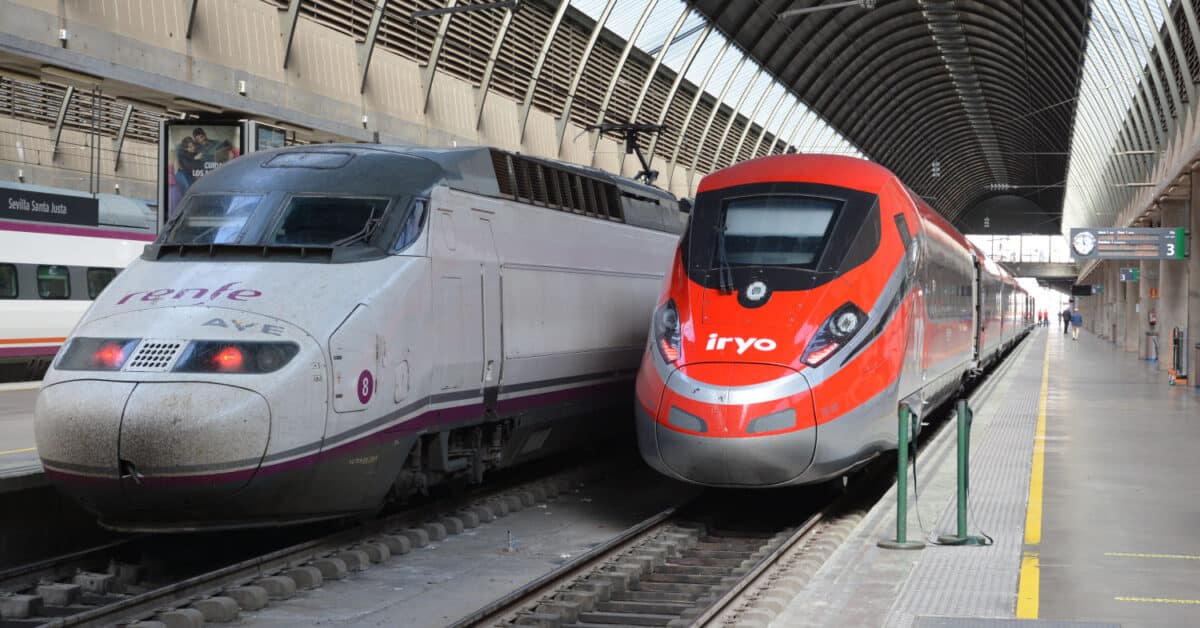
The use of rail in Spain continues to grow and is now the preferred mode of transport for 82% of travellers on seven key routes — despite the delays and disruptions that are often criticised.
The liberalisation of passenger rail services and the drop in ticket prices have cemented high-speed trains as the top choice over air travel on Spain’s major corridors. According to figures from Renfe reported by El País, 82% of passengers now opt for the train on seven main routes, resulting in an annual saving of 512,944 tonnes of CO₂. That’s equivalent to the yearly emissions of around 252,000 combustion-engine cars — roughly the entire vehicle fleet of the city of Murcia.
Renfe’s analysis shows steady growth in demand since market liberalisation. Between September 2022 and August 2025, journeys between Madrid and Barcelona increased from 7.5 to 8.9 million; Madrid–Valencia from 4.4 to 5.3 million; and Madrid–Málaga from 2.1 to 3.5 million. These figures include passengers travelling with Ouigo and Iryo.
Trenvista Premium te lleva directo, sin anuncios que hagan descarrilar tu lectura ni tu paciencia.
Únete por sólo 35€ al año, disfruta de contenidos exclusivos, más ventajas y cancela cuando quieras.
★ Empieza ahora
All this comes despite the so-called “railway chaos” touted by the opposition — which we analyse in depth further down.
Adrián Fernández, Renfe’s Director of Sustainability and Energy Efficiency, highlights that “liberalisation has been a game changer.” He explains that demand quickly shifts to rail when journey times are competitive, especially when travel times fall below the three-hour mark. On the Madrid–Barcelona route, for instance, rail’s modal share has jumped from 15% to 83% in barely a decade.
High speed as a synonym for sustainability
The emissions savings were calculated using a methodology from the International Union of Railways (UIC), which estimates that 50% of high-speed rail passengers previously flew, 20% used cars, and 30% represent new trips.
Powered entirely by renewable energy, Spain’s high-speed trains generate virtually zero direct emissions. On the Madrid–Barcelona corridor alone, rail travel avoided 185,856 tonnes of CO₂ emissions last year, 76,874 tonnes on Madrid–Seville, and 72,121 tonnes on Madrid–Málaga.
Environmental groups such as Greenpeace and Empresas por la Movilidad Sostenible underline rail’s role in transport decarbonisation. “Trains are eight times less polluting than planes, and their comfort is unrivalled when network quality and timetables align,” says Cristina Arjona, spokesperson for the environmental NGO. However, she warns that competitive pricing remains crucial to sustain this trend.
Mobility experts like social psychologist David Lois add a human factor to this preference: easier access to stations and the lack of lengthy security checks reduce travel stress, reinforcing travellers’ preference for rail.
As Fernández puts it, “Electric high-speed trains powered by renewable energy don’t just reduce emissions — they ease road congestion, improve safety, and mitigate the environmental footprint of other transport modes.” With new corridors under development, rail’s contribution to emission reduction is expected to keep growing, consolidating the sector as a pillar of sustainable mobility in Spain.
Railway chaos vs the golden age of Spanish rail
The steady growth in rail demand contrasts with the “railway chaos” denounced by opposition parties — a narrative that questions the optimistic tone of Transport Minister Óscar Puente, who claims that Spanish rail is living “its best moment.”
In broad terms, he’s right: Spain’s railways have never carried so many passengers, nor has the industry reached such levels of activity and international projection. Yet delays, breakdowns and other disruptions continue to erode passenger confidence — a mistrust amplified, it must be said, by political polarisation.
This tension reveals one of the current paradoxes of Spanish rail: while demand and political commitment to sustainable mobility are soaring, public perception of reliability is slipping. Operators and infrastructure managers such as Adif and Adif AV must now focus on improving service quality and proving that ongoing reforms are delivering results.
As price competition stabilises, the future of high-speed rail will depend less on ticket cost and more on its ability to guarantee punctuality, comfort and trust. Only then can recent growth consolidate into a lasting structural success — rather than a temporary mirage.